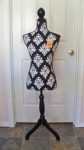
A few weeks ago, I walked into my local Hobby Lobby craft store and saw a dress form in the lobby. It was a decorative dress form that someone could use in their home décor, I suppose! When I saw it, I knew I had to buy it for photographing some of my crochet garments and accessories that I’ve created for publication. The dress form is not adjustable in width like typical sewing dress forms, but the legs come off for ease of moving the form and the height is adjustable, too. The only drawback with this dress form (if you can call it a drawback) is the fabric covering the form, which is a black and white print. Here’s a photo of the dress form by itself:
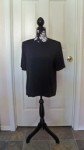
Dress Form by ItselfDress Form with Shirt
I like the fabric, but I think it might be distracting for photography! So I thought I’d cover it with a solid black top I have. Here’s how it looks with the black top covering it:
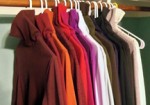
I like it with the black top covering it, but I think the print on the neck sticks out like a sore thumb!!! A good friend suggested I use turtleneck sweaters so the neck would be covered up. So I set out on a quest to buy nice turtlenecks in various colors. I found some nice turtlenecks online for $3, but every color was out of stock! That certainly didn’t help! So I decided to try some local thrift stores. First, I went to the Stepping Stones Thrift Store in Prescott Valley. They had a very nice, glittery knitted turtleneck marked down to 29 cents, so I bought it. The sales lady there suggested that I try the Disabled American Veterans Thrift Store in Prescott, so I went there later that day. To my amazement (and delight), they had a lot of turtlenecks in various colors. I found 16 more turtlenecks there for 25 cents each! So for a total of $4.29, I bought 17 turtlenecks for my dress form! Did I score or what!!! Most of these turtlenecks are my size, too, so I can wear them when I need a turtleneck (if I don’t have hot flashes from wearing them)! Here is a photo of all the turtlenecks washed and hung up:
Turtlenecks for Dress Form
You can tell that I didn’t get every color in the rainbow, but it’s a great start! I can fill in with some other colors as I find them at more thrift stores along the way.
Now I have less excuses not to self-publish my garment and accessories crochet patterns! If I could just find some extra time (and much needed discipline) to get these garment and accessories patterns done!
Stay tuned for some new patterns coming to The Crochet Architect website soon!
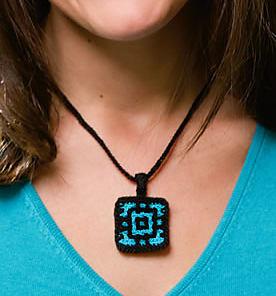
My Intermeshing Pendant Necklace (aka: Double Take Pendant Necklace) was just published in the Summer 2012 issue of Crochet! magazine. Here are some photos of the necklace:
Pendant Necklace
Both sides of Pendant Necklace
I designed this necklace pendant in the Intermeshing Crochet Technique where each side is different, as you can see in the second photo. You can learn more about this technique at Tanis Galik’s website here: www.InterlockingCrochet.com. She calls it “Interlocking Crochet”, which is the same as “Intermeshing Crochet”. She has a full book of beautiful Intermeshing/Interlocking Crochet patterns, called “Interlocking Crochet”, which is published by Krause Publications. On her website, you can see photos of some of the projects in her book, along with a link to order the book from Amazon. I have this book and it is very nice!
Anyway, back to my necklace. This is a small project that would be perfect for learning the Intermeshing/Interlocking technique of crochet. There are some step-by-step photos in the pattern, which are very helpful in understanding how the technique is done. Unfortunately, you’ll find a few mistakes in the pattern that were added during the technical editing process (many of the turning chains were moved from the end of the rows to the beginning of the wrong rows!). Here are the corrections for this pattern:
Row 2A: Remove “ch 2” at beginning of row.
Rows 2B, 3B and 4B: Change “ch 4” to “ch 2” at beginning of row.
Rows 3A and 4A: Change “ch 2” to “ch 4” at beginning of row.
Row 5A: Add “ch 4” at beginning of row.
Also, in the “Pattern Notes”, it says “After sewing pieces together”. That should say “After weaving pieces together”. These pieces aren’t “sewn”, they’re “woven”!
If you’d like to learn the “Intermeshing Crochet” technique in person, I’ll be teaching a class on Intermeshing at the CGOA Conference in Reno, NV in September, 2012. For more information about both of the CGOA Conferences, go to www.knitandcrochetshow.com. For specific information about my Intermeshing class, go to http://www.e-offinger.net/knitandcrochet/fall-classes.cfm. The class number is S209C and it’s going to be held on Saturday, September 15 from 2-5PM. I’d love to meet you in my class and teach you the Intermeshing technique!
I think Intermeshing is a fun, fascinating technique and it’s almost limitless in what you can make!
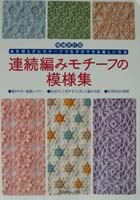
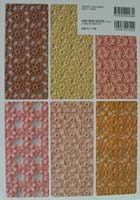
I bought a crochet book last year called “Continuous Crochet Motifs” from a Japanese seller on EBay. I paid $40.00 for this book, which is a lot to spend on a crochet book, but it is very much worth the money! It is a Japanese book with only Japanese writing inside, but it has crochet symbol charts throughout the book, which I can easily read. I quickly digested the book and learned this technique, in which motifs are made continuously, meaning there are less ends to weave in at the end (hooray!!!). You have to follow the symbol charts very carefully, but the book also includes a front section where there are both symbol charts and step-by-step photos of the motif being worked. It’s a great book and if you’re at all intrigued by this crochet technique/method, you might want to buy one of these books someday. Kristin Omdahl has a book with this technique called “Seamless Crochet”. I don’t have her book, yet, but I plan to get it soon. Here is what the Japanese Continuous Crochet Motifs book looks like on the front and back covers:
front cover of bookback cover of book
Keep in mind that when you’re using only one color, there are only 2 ends to weave in “total” because you work the motifs continuously, no matter how many motifs you make, and only fasten off at the end! That’s a huge improvement on weaving in 2 ends for every motif made!
A few weeks ago, I decided to use this technique to design something for the CGOA Design Contest, which will be held at the CGOA Conference next month in Manchester, NH. The deadline to enter something into the contest is June 6. I need to get it done within the next few weeks so there will be time for my entry to travel to the destination where it needs to be by June 6!
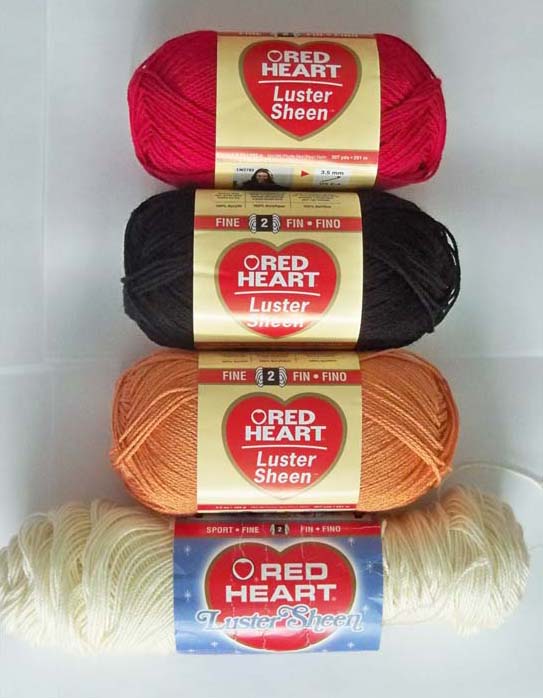
Luster Sheen colors
I can’t tell you what I’m designing, but I can tell you that I’m using some Red Heart Luster Sheen yarn to make it. I love this yarn! It is a size 2 (fine weight) yarn and is 100% acrylic. It provides beautiful drape and the colors are really nice. Here’s a photo of the yarn I’m using:
You can see that the bottom skein is different from the rest. That’s because Coats & Clark is repackaging this yarn into 3.5oz/100g skeins (they used to be 4oz/125g). There are 307 yards/281 meters in the new skeins, so it still goes a long way! The bottom color is from my stash and the top 3 colors are new. I’m using their cherry red, black, orange and vanilla colors. Since I’m using so many colors in this design, there will be plenty of ends to weave in. But I will only have 2 ends to weave in of the color that I’m using continuously around the other motifs to join them all together. That will almost CUT IN HALF the number of ends to weave in! Now that’s a big improvement in my book!!!
I noticed last week that I made one of the motifs wrong for this project, so I had to rip out a whole row of work! Ugh!!! I had only worked the second round and left out the first round in each of the motifs (that’s what happens when I’m preoccupied and don’t look at the symbol chart I made!). Here’s how the motif looks (the left motif is missing round 1, but the right motif has both rounds worked):
joined and unjoined round 1
I took a few minutes to decide if it was going to make a difference before ripping it out, though. I decided it would look better if I made the motifs the right way (the chain spaces are more pronounced in the correct motif on the right), so the extra time would make a difference in the look of the project. When I ripped it out, I decided to engineer the motif a little differently. Originally, I had designed it with 2 rounds and both rounds were joined at the end. However, I tried it with not joining the first round and only joining the second round. Here is a photo of the difference between the two joinings:
The motif on the left is joined at the end of both rounds. The motif on the right is joined at the end of the second round only. I see less bulk in the joining area, so that’s what I’m going to do for these motifs. The new motif goes straight from the last sc in the first round to the first sc in the second round without the usual “sl st” at the end of the round and “ch 1” before the first sc of the next round. What do you think? Do you like the newer motif better or do you not see any difference between them? I know, it’s very minimal, but if I had to rip them out anyway, I might as well make the change!
Let’s hope I stay on schedule and get this done in time for the contest (if I don’t get distracted with something else along the way)!
I decided to start designing a garment today (it’s a long process, but if I don’t get started, it’ll never get done!). Last Fall, I took a class at the CGOA Conference in Greensboro, NC, taught by Joan Davis, called “Crochet Fabulous Fashions from Commercial Sewing Patterns”. In the class, I learned some things about designing a crochet garment and I’m ready to give it a try! Anyway, I’m going to design a garment using the sizes and shapes of the pieces in a particular sewing pattern and see how it works out (hopefully it will look great or it’ll be back to the drawing board for me!).
I decided I wanted stronger pattern pieces than the pattern has in it so they wouldn’t get torn too easily. I also wanted to keep an uncut original pattern with the 3 sizes that the pattern comes with intact (to make sizing the crochet garment pattern easier to do later on). So I got started with tracing the sewing pattern pieces for the garment I want to make.
Step 1
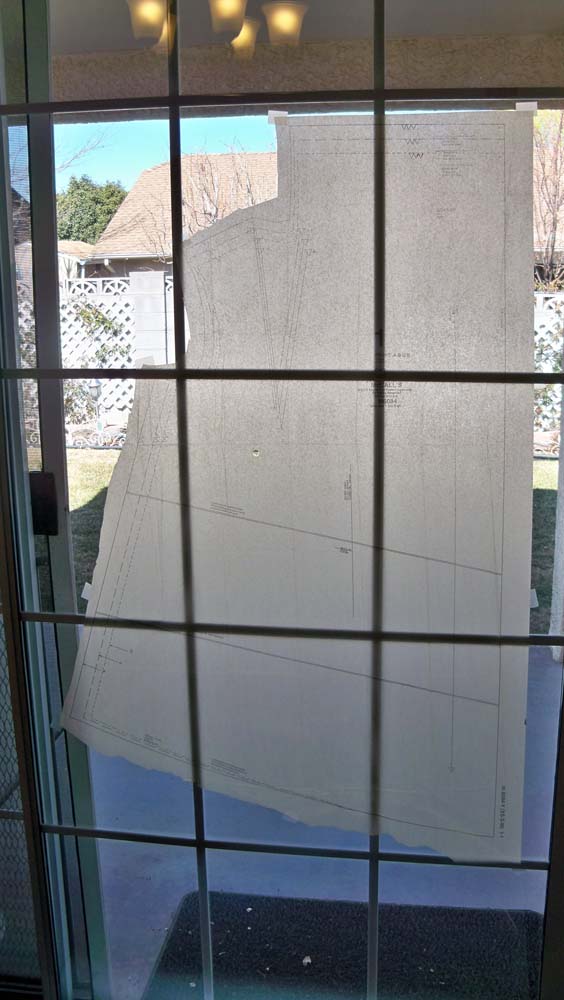
The first thing I needed to do was read the pattern, cut apart the pattern pieces and decide which size I wanted to make. Then I taped the pieces, one at a time, to my sliding glass door like this:
Step 2
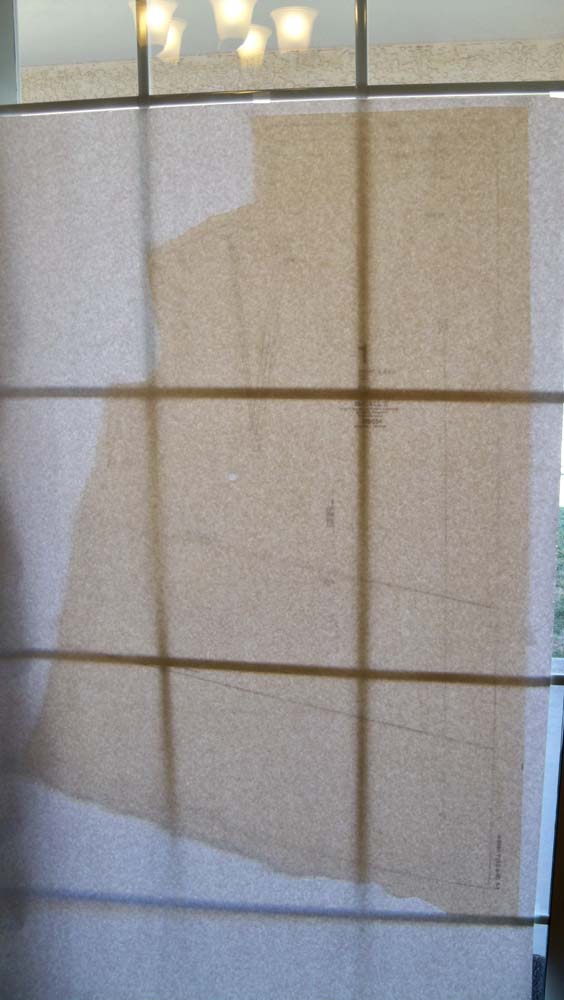
After taping the pattern piece to the sliding glass door, I taped a big sheet of paper to the door on top of that. I used part of an “end roll” from my local newspaper printing facility. They sell the “end rolls” for a few dollars and they’re really handy for all types of crafts! Of course, I had to do this during the day because I’m using the sunshine outside to see through to the bottom layer of paper! Here’s what it looked like after taping the top layer onto the sliding glass door:
Step 3
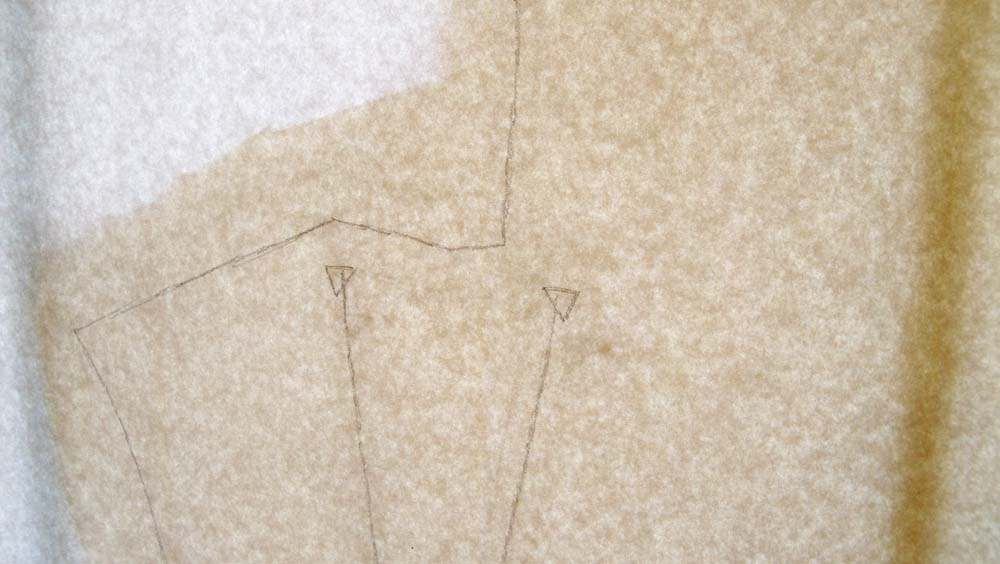
After taping both of these pieces to the sliding glass door, I drew the cutting lines from the size of the pattern that I want to make onto the top layer of paper like this:
Step 4
These cutting lines on the pattern are for cutting out each piece of fabric to make the garment. Most people know that sewing patterns have a built in seam allowance (usually 5/8″) on each pattern piece. But for a crochet pattern, I want to remove the seam allowance because crochet seams aren’t that wide. So I drew lines 5/8″ in from the cutting lines that I traced from the pattern pieces (after verifying that there were 5/8″ seams around all edges of the pattern pieces per the instructions in the pattern). Here’s what the pattern piece looked like after drawing those new lines:
Step 5
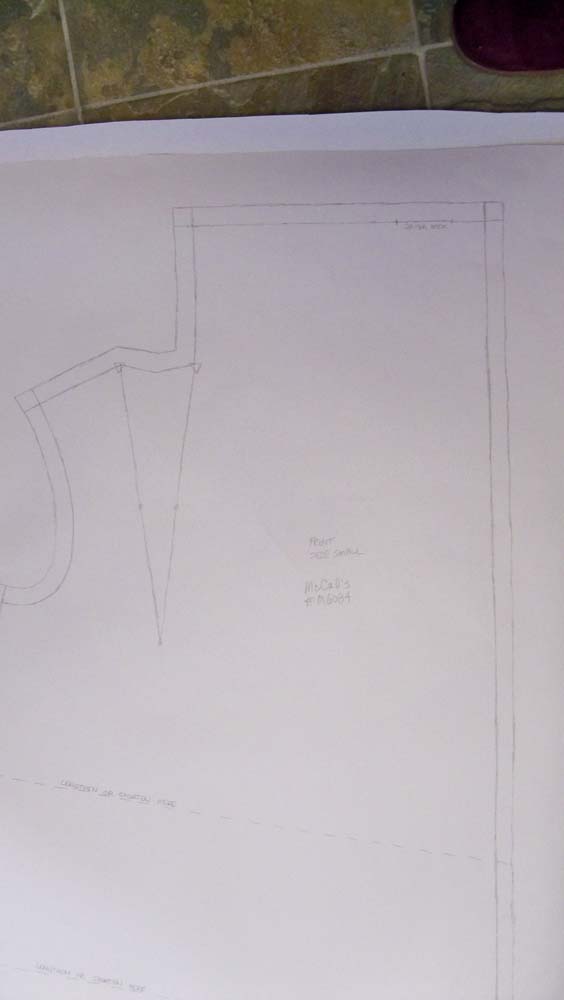
After drawing the new cutting lines (5/8″ in from the sewing pattern cutting lines), I cut out the pattern pieces along my new cutting lines like this:
Step 6
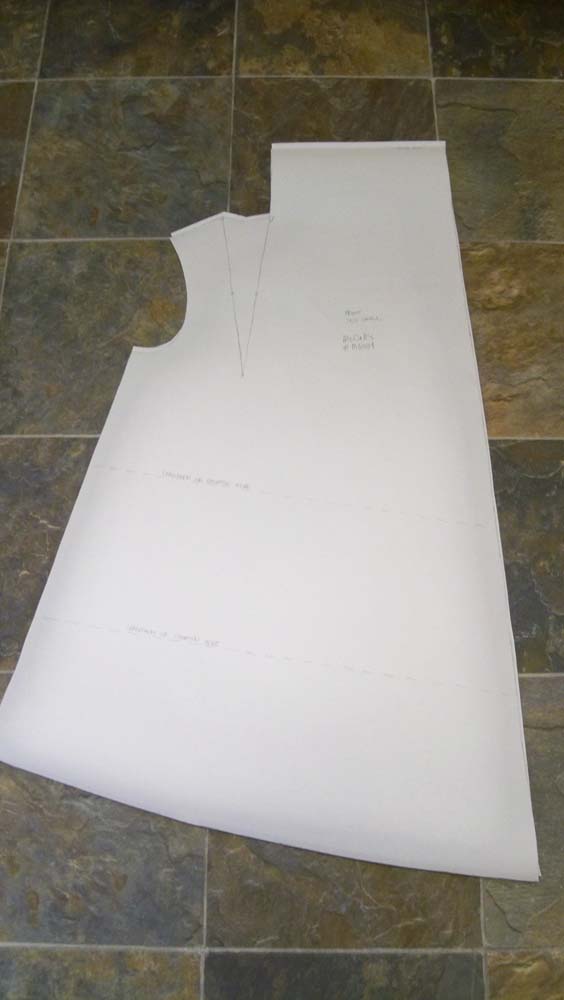
And here’s how my new pattern piece looks after cutting it out:
I now have a new pattern piece for each of the pieces in this garment pattern with the seam allowances removed. I will use each of these pattern pieces to crochet a front, back and 2 sleeves for this garment that will be the size and shape of each pattern piece. Then I’ll sew the crocheted front, back and sleeve pieces together to form my crochet garment pattern. And I’ll be able to calculate the different numbers of stitches and rows for each size of the crochet pattern by using the original, uncut sewing pattern, which is sized already (I’m a visual person, so these pieces should help me tremendously!)! Since this particular sewing pattern comes in 3 sizes (XS, S and M) per pattern packet, I also bought the pattern packet with the larger 3 sizes (L, XL and XXL) to grade the pattern fully. I bought the 2 patterns when they were on sale for $1 each, so that didn’t break my bank account! I can’t believe how expensive sewing patterns are now. The retail price of each pattern says $17.95! I’d never pay that much for a sewing pattern, especially a pattern rated “easy”!
Now all I need to do is play around with some yarn, different sizes of crochet hooks and crochet stitch patterns to decide how this garment will be made. That may not be as easy as it sounds, but I’m up for the challenge!
I’ll post more as this garment progresses (unless it’s a total loss!). Wish me luck!