Crochet as Art: Architectural Crochet

I really love to crochet and to design new crochet patterns (basically, I love to make things!). But not just the typical types of crochet projects: scarves, hats, ponchos, shawls, garments, potholders, coasters, placemats, jewelry, etc. Sometimes I like to design something different and challenging. I get bored doing the same thing over and over. That’s why I like to change what I do from time to time!

Did you know that you can make artistic, 3-D items in crochet? I’ve designed and crocheted several myself. I’ll show you those a little later in this blog post. But first, I’d like to show you some of the amazing things that some crochet artists are creating around the world. These projects are very inspiring and really amazing!!!
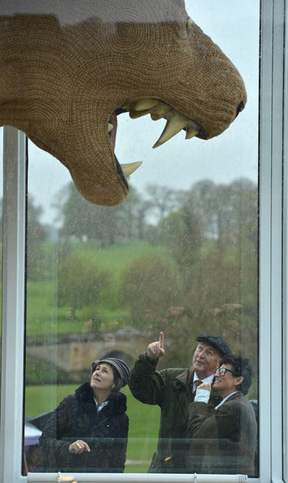
Lion Head from The Lionheart Project

The first artist I’d like to share with you is Shauna Richardson. Shauna spent 2 years and used 36 miles of Swaledale wool from the Derbyshire Dales to crochet three giant 29 foot lion figures, known as “The Lionheart Project”! These lions are an interpretation of the three golden lions on Richard the Lionheart’s coat of arms. These lions are amazing!!! It would be wonderful to see these in person! These are just a few of the photos of this amazing creation. In these two photos, Shauna is chatting with the Duke and Duchess of Devonshire as they stand next to her project on May 1, 2012 in Chatsworth, England. The work will tour the East Midlands before moving to London’s Natural History Museum as part of the 2012 Cultural Olympiad. There are more photos of Shauna’s work and this impressive sculpture here: www.shaunarichardson.com and www.lionheartproject.com. And here is a website where you can watch a BBC video on this project: http://www.bbc.co.uk/news/uk-england-derbyshire-17922125.
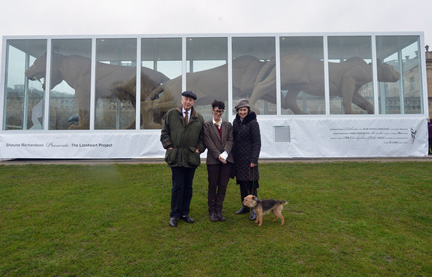
Display of The Lionheart Project


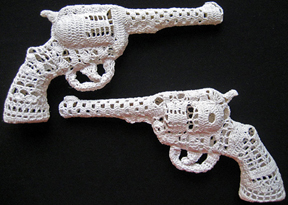
Crochet Pistols

Now for something a lot smaller! I saw these crocheted pistols online one day by Inger Carina and thought they were pretty amazing! I hadn’t seen any crocheted guns before I saw these. Isn’t it amazing what you can create with just a crochet hook, some crochet thread and some fabric stiffener (and some guns to mold them around, of course)? I would have never thought to crochet guns!!! Now that’s imagination for you! You can see more of Inger’s work at www.hellocraftlovers.com.
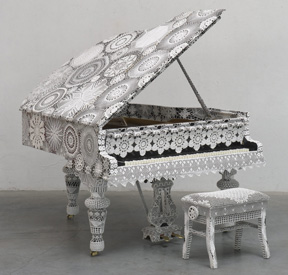
 

Piano covered with doilies

If you’re wondering what to do with all those doilies you’ve made and/or collected over the years, here is an idea for you. How about covering a piano with them? I think this covered piano is awesome!!! There are a whole lot of doilies covering this piano! Of course, I LOVE doilies!!! This was done by Joana Vasconcelos. You can see more of her work at www.joanavasconcelos.com.

These are just a few of the crochet artists in the world. Aren’t they amazing?


Well, my crochet art isn’t as nice as these fabulous pieces, but it’s not bad! First, here is my locomotive afghan and toy, which were published in the December 2009 issue of Crochet World magazine:
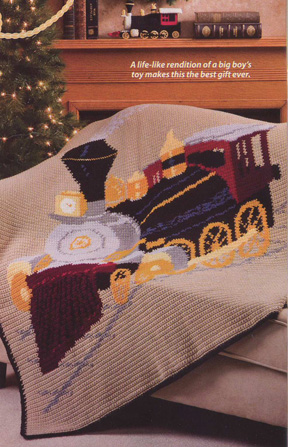
Locomotive Afghan


The locomotive afghan was made with 9 colors of Red Heart Super Saver yarn. It measures 48” x 60”. When designing this afghan, the first thing I needed to do was find a good photo of a locomotive at the desired angle I wanted. Since I had trouble finding a good photo, I took some photos of a plastic toy locomotive that we used many years before under our Christmas tree (it had optional smoke, too). After making a gauge swatch, I decided how many stitches and rows the afghan should have for the desired size. Then I imported the photo into my computer charting program and tweaked the colors in the chart to make a good intarsia pattern that didn’t have too many color changes involved.
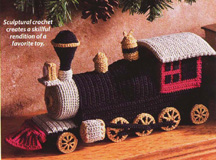


Locomotive Toy


The locomotive toy was made with 5 colors of J&P Coats Royale Classic and Metallic crochet thread in size 10. Many parts of the toy are crocheted with 2 strands of crochet thread held together. I used plastic canvas, cut into various sizes, to provide a “skeleton” for the crochet to fit over for the body of the locomotive. I also used polyester fiberfill to stuff many of the pieces. Since I didn’t know much about locomotives at the time, I checked out some books at my local library with photos of locomotives. And I asked a friend’s husband with locomotive knowledge some questions about the names of the parts of the locomotive so I could label them correctly in the pattern! It was a long process, but I think it was well worth it! This locomotive toy was a challenge to design, but it was actually quite fun!


Here’s a tent, sleeping bag, beret, vest and ammo belt that I designed for a GI Joe (or similar) doll:
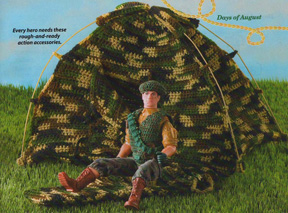
GI Joe Tent and Gear

This pattern was published in the August 2009 issue of Crochet World magazine (it was called “Camouflage Gear” in the magazine). The vest, beret, ammo belt and sleeping bag weren’t too difficult to design with the doll that I had received from the magazine editor to use. But the tent was a challenge!!! After trying several times to make the tent, I decided I needed to make a paper form of the tent first. Then I crocheted the pieces to fit the form. I cut a wire coat hanger and bent the wire a little to form the tent “poles”. I used pieces of a glue stick for the ends of the tent poles so they wouldn’t poke through the crochet pieces at the bottom corners of the tent. I even crocheted the door flap for the tent, with crocheted chains for tie straps to keep the door flap open or closed. I used Red Heart Sport yarn for the tent and sleeping bag and Aunt Lydia’s Classic size 10 crochet thread for the ammo belt, vest and beret. And I used bugle beads for the “ammo” in the ammo belt!


Here is my Majestic Butterfly afghan that was published as a web bonus in Crochet! magazine’s Spring 2012 issue:
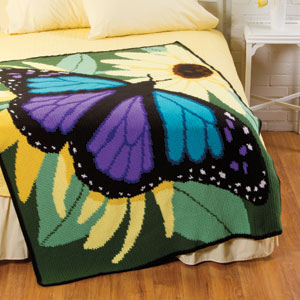
Majestic Butterfly Afghan

This afghan was made as a request from Cari Clement at Caron yarns. She liked my locomotive afghan at the CGOA Conference the year before and asked me to design an intarsia afghan for Caron. So I started looking for photos of butterflies to use. I finally found one and used the same computer charting program to import the photo (after deciding how many stitches and rows the afghan would need). I had to do a lot of tweaking on this one to get the colors to work and not have too many color changes throughout the rows. I think it turned out nicely!


And last, but not least, is my Dragon Ship, which was published as a web bonus in Crochet World’s February, 2011 issue. The reason it wasn’t published in the magazine itself, but as a web bonus, is the pattern was way too long!!! I also won a Flamie award for this ship last year! The ship is designed to look like the ship in “The Voyage of the Dawn Treader” movie! The editor for Crochet World magazine at the time, Michele Maks, asked me to design this ship well before the movie was released, so finding online photos of it being built wasn’t all that easy!
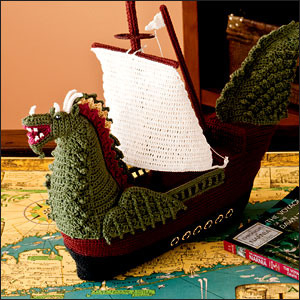
Dragon Ship
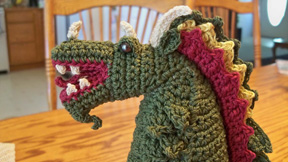
The head on my Dragon Ship

This dragon ship was the biggest challenge for me so far! I made at least 3 different heads for the dragon before I got one that didn’t look dorky!!! The dragon itself has a head, neck, wings and tail. I included teeth and a tongue in the open mouth, along with a goatee under the chin, horns, ears and bead eyes with eyelids on top of the head. The crochet stitches I chose for the sides of the neck and the tail look like scales! And I used some post stitches for added texture on the dragon’s wings. The ship includes a hull with embroidered port holes, deck, stern cabin (at the back of the ship below the tail), 2 masts, a sail, flag, lookout and side railings. I used 7 colors of America’s Best Crochet Thread, size 10 for this ship. I added cardboard pieces under the deck and under the top and front pieces of the stern cabin for strength and added shaping. I put poly pellets at the bottom of the hull and stuffed the rest of the hull with polyester fiberfill. I inserted wire at the bottom of the sail to help shape it. I stiffened the flag, lookout and 2 pieces that I made to attach the masts to the deck. My only regret is not engineering the masts and deck so the masts would not flop around! But all in all, I think this dragon ship looks pretty good!


I hope you’ve enjoyed looking at these pieces of crochet art (mine and the other designer’s pieces)! And I hope I’ve inspired you to try some crochet art in the near future!

Happy crocheting,

Susan

Crochet Jewelry

You’ve probably seen crochet jewelry all over the place, but have you made any of it yet? I absolutely LOVE making (and wearing) crochet jewelry, whether it is one of my designs or someone else’s design!

Crochet jewelry that is made with cotton crochet thread (my favorite) is hand washable, so it will last for years! You can use any colors of crochet thread for making your crochet jewelry to coordinate with your wardrobe. The fasteners on crochet necklaces can be barrel clasps or buttons. Some are even long enough to fit over the head, so they don’t need any fasteners! Many crochet jewelry pieces take just a few hours to make, so they’re instant gratification projects, which I love!!!

Here are a few pieces of crochet jewelry that I’ve made from other designer’s patterns:

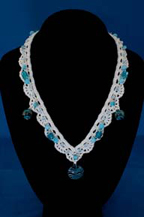
My Favorite Necklace


This is my favorite necklace, made with size 20 thread. The pattern is from a Magic Crochet magazine, Issue #64, Feb. 1990. I LOVE this necklace! It looks great on and is easy to clean when it gets dirty. I wear it a lot! I even made some coordinating leaf earrings to wear with it. The clasp is a simple button and crocheted buttonhole.


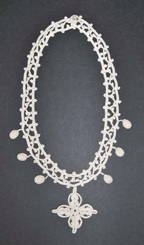
Necklace With Balls


This necklace is fun to wear. It’s made with size 10 thread and includes matching “ball” earrings. I think this pattern was from a Japanese book by Kazekobo.


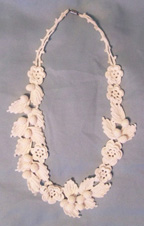
Irish Crochet Necklace


This Irish Crochet Necklace was made with size 20 or 30 thread. It’s too fancy to wear with just anything! The chains near the back of the necklace (at the top of the photo) twist easily, so I don’t wear this one very often. This necklace may have been from the same book by Kazekobo.


Here are some crochet jewelry pieces that I’ve designed for Crochet Today magazine over the years:

Lacy Grannies Bracelet
Jan/Feb 2008
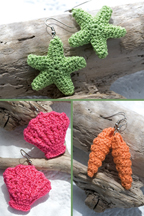
Seashore Earrings
July/Aug 2009


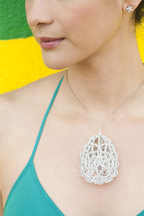
Crystal Pendant Necklace
July/Aug 2010


There is a large, clear crystal sandwiched in the center of the 2 sides of crochet in my Crystal Pendant Necklace! It’s pretty cool!!!


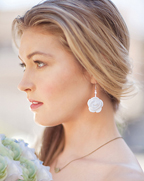
Bouquet Earrings
May/June 2012


The Bouquet Earrings were made in white for a bride, but can be made in any flower color you choose!


Winter Berry Earrings
Nov/Dec 2012


The Winter Berry Earrings are made with some shiny crochet thread, called Anchor Artiste Metallic. It’s a very pretty thread. The photo doesn’t do it justice!


Here are some of the other crochet jewelry pieces that I’ve designed:

Beaded Shells Necklace
(longer version)
Beaded Shells Necklace
(shorter version)

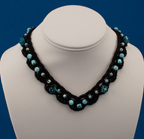
This is my Beaded Shells Necklace, available for purchase at TheCrochetArchitect.com. The pattern comes in 2 versions: long and short. They both have small beads throughout, but the longer version includes 1 large center bead and 2 medium beads.


Faux Tatted Necklace with buttons
Faux Tatted Necklace with beads

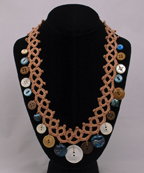
This is my Faux Tatted Necklace pattern, also available for purchase at TheCrochetArchitect.com. This necklace is actually crocheted to look like tatting, which has rings, chains and picots. This pattern can be made with buttons, beads or charms. It is a fun project to make with heirloom buttons or buttons with memories attached!


I love making these crochet necklaces and earrings because they’re so versatile!

For my Faux Tatted Necklaces (I’ve made quite a few), I’ve used many different colors of size 10 crochet thread and beads or buttons to coordinate with some of the outfits in my wardrobe. This necklace doesn’t have a clasp, so you just pop it over your head and wear it (it’s great if you have an injured hand, wrist or arm!). I should be coming out with a pattern for a coordinating Faux Tatted Bracelet and Earrings soon, so you can wear a complete set of Faux Tatted jewelry, if you like!

Why not make some crochet jewelry for your next project? If you do, please drop me a line and let me know how it turned out!

Happy crocheting!

Susan


New Patterns, Finally!!!

We have 3 new crochet patterns for you at The Crochet Architect. They’re all fun to crochet and will be a wonderful addition to your kitchen table or to use for outdoor dining!

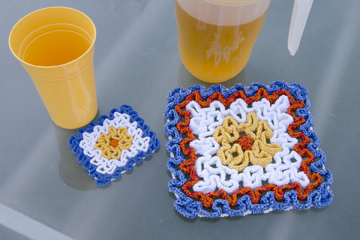
Wiggly Flower Hot Pad & Coaster

The first is our WIGGLY FLOWER HOT PAD & COASTER. This set is made in the wiggly crochet technique with size 10 cotton crochet thread. The hot pad is made with 3 strands of the thread and the coaster is made with only one strand.

This pattern includes written instructions and wiggly crochet charts for both designs.

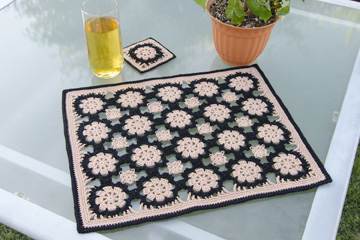
Byzantine Placemat & Coaster


The second is our BYZANTINE PLACEMAT & COASTER. This set is made with any 2 colors of size 3 cotton crochet thread. The placemat is made with large and small motifs, which are joined together while working the last round of each motif. Then an edging is worked around the joined motifs for the perfect finish. The coaster is made from only one of the large, round motifs, with an edging added to make it square.

This pattern includes written instructions, a crochet symbol chart for each project and an assembly diagram for the placemat.

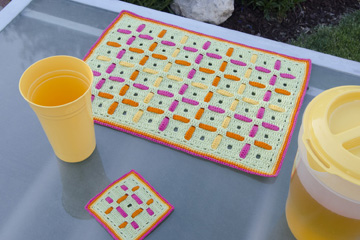
Filet Woven Placemat Set

The third is our FILET WOVEN PLACEMAT SET. This placemat set is made in the filet crochet method with double crochet stitches and ch-2 spaces. It has added crochet strips of contrasting colors that are woven through the appropriate ch-2 spaces for visual interest! The placemat is made with 2 strands of size 10 cotton crochet thread held together throughout and the coaster is made with only one strand of the same threads. You can choose to make these projects in any colors you desire for spring, summer, fall or winter décor!

This pattern includes written instructions and a crochet symbol chart for each project.

I hope you enjoy these patterns and the extra pizzazz they are sure to bring to your table! If you have any questions about these patterns, please don’t hesitate to ask!

Happy crocheting,

Susan
Continuous Crochet Motifs

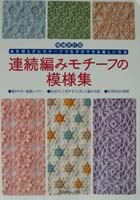
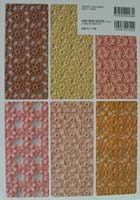
I bought a crochet book last year called “Continuous Crochet Motifs” from a Japanese seller on EBay. I paid $40.00 for this book, which is a lot to spend on a crochet book, but it is very much worth the money! It is a Japanese book with only Japanese writing inside, but it has crochet symbol charts throughout the book, which I can easily read. I quickly digested the book and learned this technique, in which motifs are made continuously, meaning there are less ends to weave in at the end (hooray!!!). You have to follow the symbol charts very carefully, but the book also includes a front section where there are both symbol charts and step-by-step photos of the motif being worked. It’s a great book and if you’re at all intrigued by this crochet technique/method, you might want to buy one of these books someday. Kristin Omdahl has a book with this technique called “Seamless Crochet”. I don’t have her book, yet, but I plan to get it soon. Here is what the Japanese Continuous Crochet Motifs book looks like on the front and back covers:

front cover of book
back cover of book

Keep in mind that when you’re using only one color, there are only 2 ends to weave in “total” because you work the motifs continuously, no matter how many motifs you make, and only fasten off at the end! That’s a huge improvement on weaving in 2 ends for every motif made!


A few weeks ago, I decided to use this technique to design something for the CGOA Design Contest, which will be held at the CGOA Conference next month in Manchester, NH. The deadline to enter something into the contest is June 6. I need to get it done within the next few weeks so there will be time for my entry to travel to the destination where it needs to be by June 6!

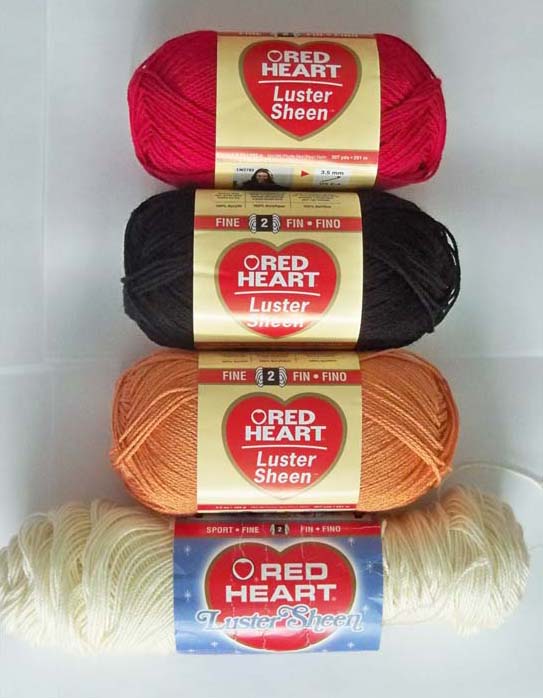
Luster Sheen colors

I can’t tell you what I’m designing, but I can tell you that I’m using some Red Heart Luster Sheen yarn to make it. I love this yarn! It is a size 2 (fine weight) yarn and is 100% acrylic. It provides beautiful drape and the colors are really nice. Here’s a photo of the yarn I’m using:

You can see that the bottom skein is different from the rest. That’s because Coats & Clark is repackaging this yarn into 3.5oz/100g skeins (they used to be 4oz/125g). There are 307 yards/281 meters in the new skeins, so it still goes a long way! The bottom color is from my stash and the top 3 colors are new. I’m using their cherry red, black, orange and vanilla colors. Since I’m using so many colors in this design, there will be plenty of ends to weave in. But I will only have 2 ends to weave in of the color that I’m using continuously around the other motifs to join them all together. That will almost CUT IN HALF the number of ends to weave in! Now that’s a big improvement in my book!!!

I used Luster Sheen yarn in my Two-Way Rose Pin design (you can see it on Ravelry here: http://www.ravelry.com/patterns/library/two-way-rose-pin). I also used Luster Sheen yarn when I crocheted a filet afghan to be photographed in the book “Afghans for All Reasons & All Seasons”, which Jean Leinhauser and Rita Weiss produced for Leisure Arts. Here’s a link to a photo of that afghan on Amazon (it’s on the front cover in the top right-hand corner): http://www.amazon.com/Afghans-Reasons-Seasons-Leisure-Arts/dp/160140672X#reader_160140672X.

wrong and right motif

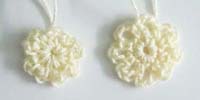
I noticed last week that I made one of the motifs wrong for this project, so I had to rip out a whole row of work! Ugh!!! I had only worked the second round and left out the first round in each of the motifs (that’s what happens when I’m preoccupied and don’t look at the symbol chart I made!). Here’s how the motif looks (the left motif is missing round 1, but the right motif has both rounds worked):


joined and unjoined round 1

I took a few minutes to decide if it was going to make a difference before ripping it out, though. I decided it would look better if I made the motifs the right way (the chain spaces are more pronounced in the correct motif on the right), so the extra time would make a difference in the look of the project. When I ripped it out, I decided to engineer the motif a little differently. Originally, I had designed it with 2 rounds and both rounds were joined at the end. However, I tried it with not joining the first round and only joining the second round. Here is a photo of the difference between the two joinings:

The motif on the left is joined at the end of both rounds. The motif on the right is joined at the end of the second round only. I see less bulk in the joining area, so that’s what I’m going to do for these motifs. The new motif goes straight from the last sc in the first round to the first sc in the second round without the usual “sl st” at the end of the round and “ch 1” before the first sc of the next round. What do you think? Do you like the newer motif better or do you not see any difference between them? I know, it’s very minimal, but if I had to rip them out anyway, I might as well make the change!

Let’s hope I stay on schedule and get this done in time for the contest (if I don’t get distracted with something else along the way)!

Happy crocheting,

Susan
Designing a Crochet Garment from a Sewing Pattern, Part 1

I decided to start designing a garment today (it’s a long process, but if I don’t get started, it’ll never get done!). Last Fall, I took a class at the CGOA Conference in Greensboro, NC, taught by Joan Davis, called “Crochet Fabulous Fashions from Commercial Sewing Patterns”. In the class, I learned some things about designing a crochet garment and I’m ready to give it a try! Anyway, I’m going to design a garment using the sizes and shapes of the pieces in a particular sewing pattern and see how it works out (hopefully it will look great or it’ll be back to the drawing board for me!).

I decided I wanted stronger pattern pieces than the pattern has in it so they wouldn’t get torn too easily. I also wanted to keep an uncut original pattern with the 3 sizes that the pattern comes with intact (to make sizing the crochet garment pattern easier to do later on). So I got started with tracing the sewing pattern pieces for the garment I want to make.

Step 1

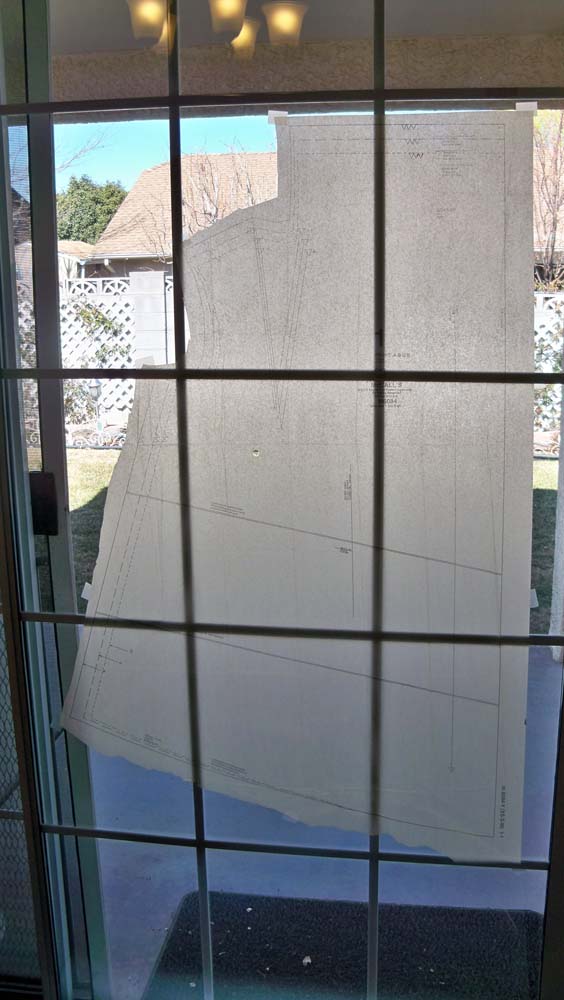
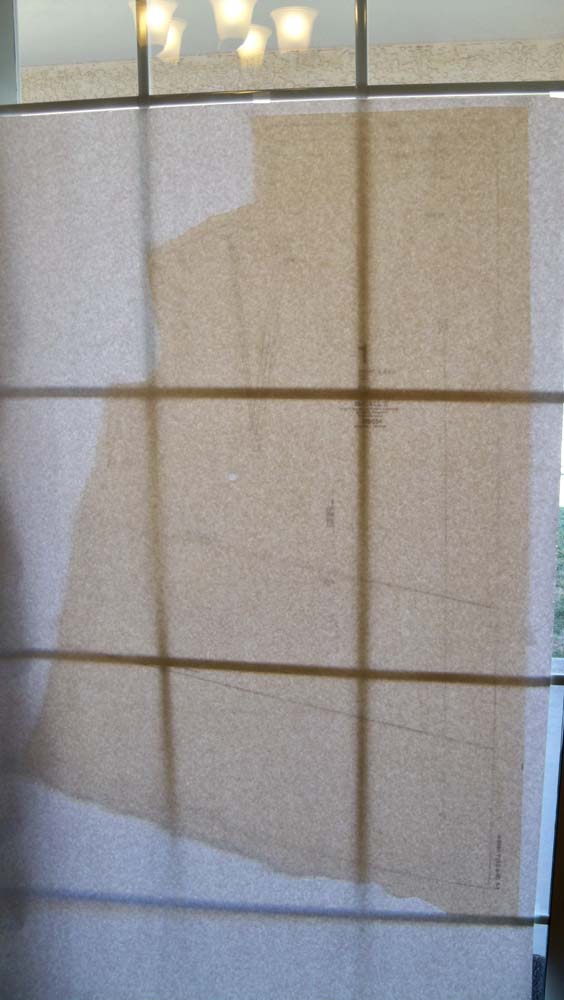
The first thing I needed to do was read the pattern, cut apart the pattern pieces and decide which size I wanted to make. Then I taped the pieces, one at a time, to my sliding glass door like this:


Step 2


After taping the pattern piece to the sliding glass door, I taped a big sheet of paper to the door on top of that. I used part of an “end roll” from my local newspaper printing facility. They sell the “end rolls” for a few dollars and they’re really handy for all types of crafts! Of course, I had to do this during the day because I’m using the sunshine outside to see through to the bottom layer of paper! Here’s what it looked like after taping the top layer onto the sliding glass door:

Step 3


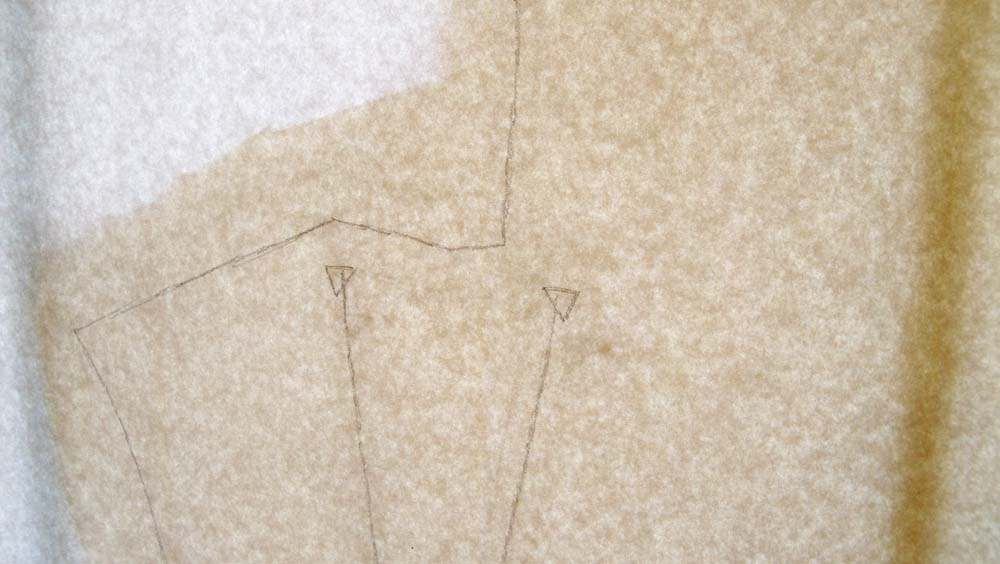
After taping both of these pieces to the sliding glass door, I drew the cutting lines from the size of the pattern that I want to make onto the top layer of paper like this:


Step 4


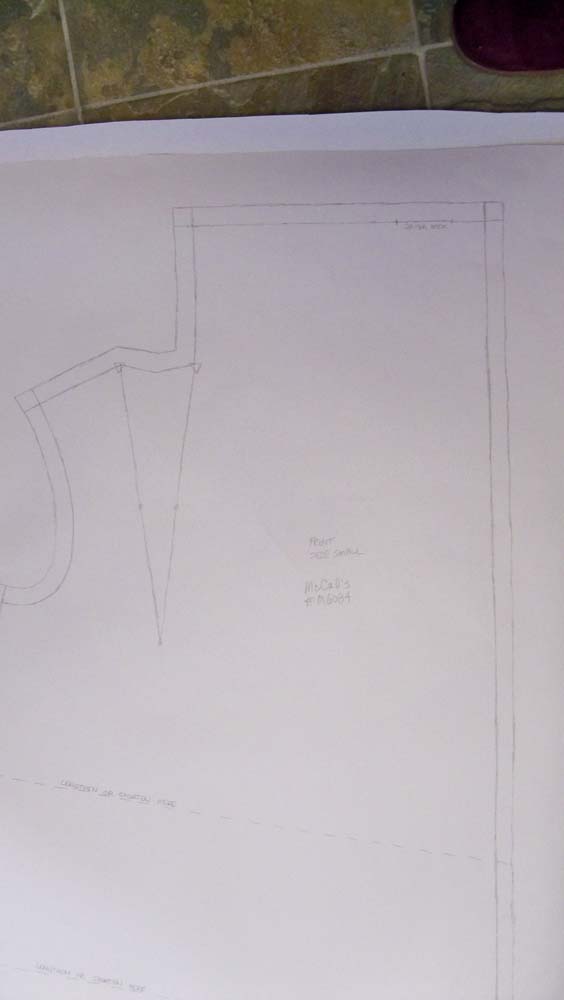
These cutting lines on the pattern are for cutting out each piece of fabric to make the garment. Most people know that sewing patterns have a built in seam allowance (usually 5/8″) on each pattern piece. But for a crochet pattern, I want to remove the seam allowance because crochet seams aren’t that wide. So I drew lines 5/8″ in from the cutting lines that I traced from the pattern pieces (after verifying that there were 5/8″ seams around all edges of the pattern pieces per the instructions in the pattern). Here’s what the pattern piece looked like after drawing those new lines:


Step 5


After drawing the new cutting lines (5/8″ in from the sewing pattern cutting lines), I cut out the pattern pieces along my new cutting lines like this:


Step 6

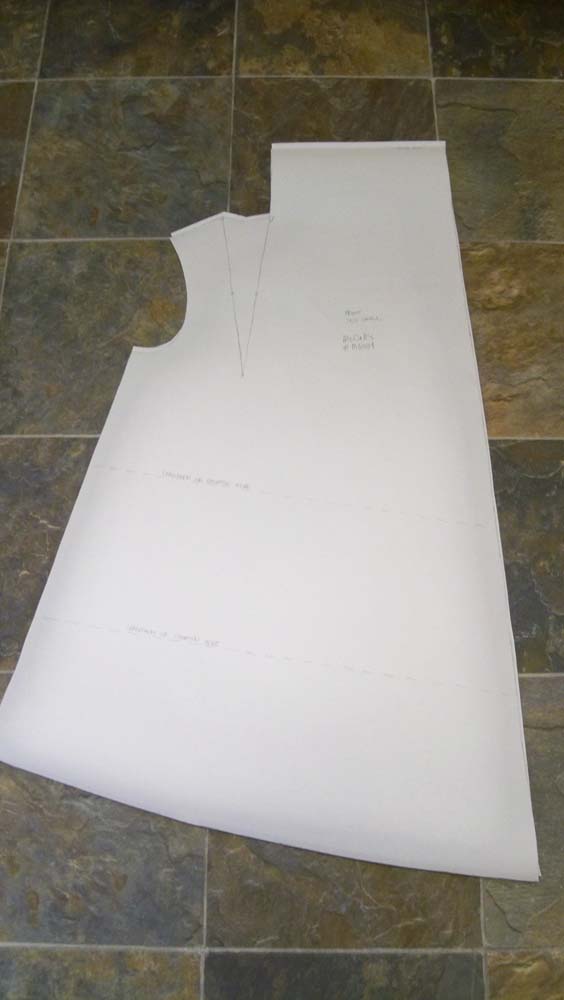
And here’s how my new pattern piece looks after cutting it out:


I now have a new pattern piece for each of the pieces in this garment pattern with the seam allowances removed. I will use each of these pattern pieces to crochet a front, back and 2 sleeves for this garment that will be the size and shape of each pattern piece. Then I’ll sew the crocheted front, back and sleeve pieces together to form my crochet garment pattern. And I’ll be able to calculate the different numbers of stitches and rows for each size of the crochet pattern by using the original, uncut sewing pattern, which is sized already (I’m a visual person, so these pieces should help me tremendously!)! Since this particular sewing pattern comes in 3 sizes (XS, S and M) per pattern packet, I also bought the pattern packet with the larger 3 sizes (L, XL and XXL) to grade the pattern fully. I bought the 2 patterns when they were on sale for $1 each, so that didn’t break my bank account! I can’t believe how expensive sewing patterns are now. The retail price of each pattern says $17.95! I’d never pay that much for a sewing pattern, especially a pattern rated “easy”!

Now all I need to do is play around with some yarn, different sizes of crochet hooks and crochet stitch patterns to decide how this garment will be made. That may not be as easy as it sounds, but I’m up for the challenge!

I’ll post more as this garment progresses (unless it’s a total loss!). Wish me luck!