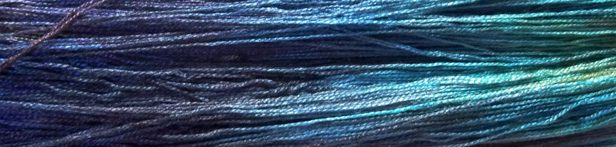
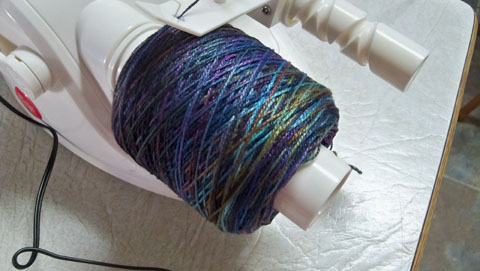
Have you ever bought some gorgeous yarn that’s in a hank instead of a ball and asked yourself “How am I going to wind this into a ball”? Obviously, you can’t crochet or knit something with the yarn if it’s in a hank and not a ball or it would tangle uncontrollably! I bought some gorgeous lace weight bamboo yarn at the CGOA Conference in Manchester, NH this year and decided I’d better wind it into a ball so I can use it sometime soon. I love the colors that are in this yarn, don’t you?
Gorgeous bamboo yarn
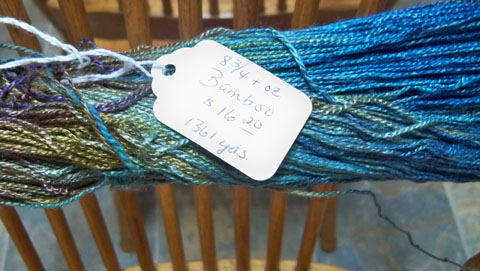
Here’s a look at the tag that came on this gorgeous yarn to see how much yardage I got for my money:
Bamboo yarn tag
This yarn was sold by The Fiber Studio LLC in Henniker, NH. I think the yardage is great for the price and the fiber content (1,361 yards of hand-dyed bamboo yarn for only $16.20)! Anyway, I should have plenty of yardage to crochet something gorgeous, after I decide on the perfect item to make/design with it. I can’t wait!
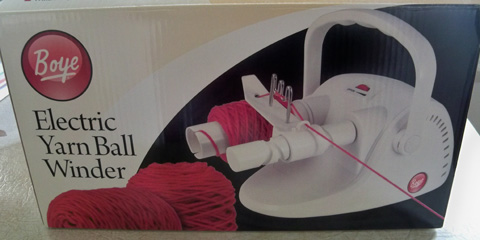
I don’t know about you, but I don’t own a yarn swift yet. However, I do own both a manual and an electric yarn ball winder. I was blessed to win a Boye Electric Yarn Ball Winder at Professional Development Day at the CGOA Conference a few years ago! What a treat! It’s a big time saver, as well as a muscle saver, especially when winding this many yards of yarn!!! But it’s not foolproof. You have to keep an eye on it and make sure nothing goes wrong, so don’t leave the room while it’s winding the yarn! I had a big mess of yarn once when the yarn slid off the winder while it was being wound! If I had been in the same room, I would have noticed it sooner and wouldn’t have had as big of a mess! The electric yarn ball winder does an excellent job of winding the yarn and I really enjoy having it. Here’s a picture of the box for the electric winder:
Boye Electric Yarn Ball Winder
This electric yarn ball winder is available from many websites and at some local craft stores. You can watch a demo video of this yarn winder on YouTube here: http://www.youtube.com/watch?v=Yt83Fui5rDA.
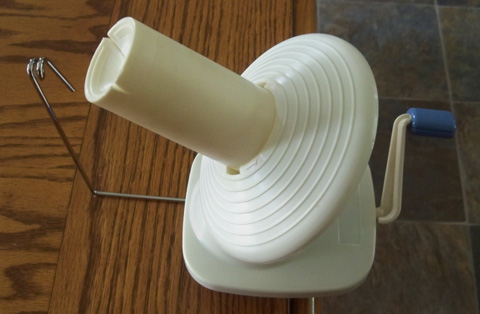
I use my manual yarn winder when I have small amounts of yarn to wind. It hooks onto the table (the table can’t be too thick, though) and you have to manually turn the handle to wind the yarn or crochet thread onto it. I will often slide half of a toilet paper roll onto the center of the manual yarn winder before using it to wind crochet thread so there is a “core” inside the thread when I’m done. It helps to keep all the neatly wound thread together later on. Here’s a picture of the manual yarn winder:
Manual yarn winder
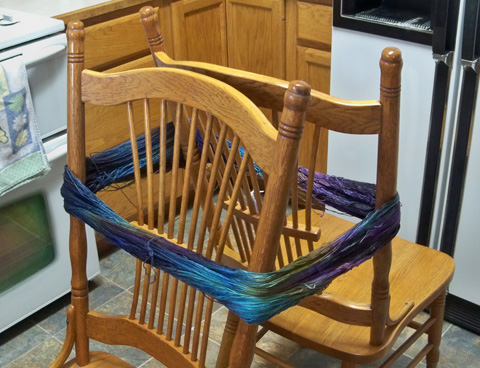
Well, back to my invisible yarn swift (I’ll buy one sometime, I promise!). Since I wanted to wind this yarn and not have it terribly tangled, I had to improvise on a yarn swift. So I put 2 dining room chairs back to back in my kitchen and placed the hank of yarn over the back of the 2 chairs to hold it in place. Then I moved the chairs to the appropriate distance apart to support the yarn. Here’s what the yarn looked like around the back of the 2 chairs:
Improvised yarn swift
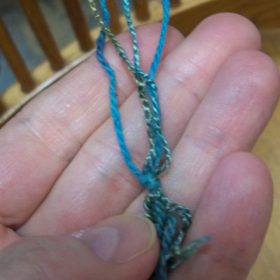
After I was satisfied with my makeshift swift, I removed the strand that was tied around the hank. Here’s what the ends looked like before freeing the tied ends:
Bamboo yarn ends
There was another 1 or 2 strands of yarn/thread tied around the hank that I removed, also. Then I started winding the yarn with the electric yarn ball winder. Since this yarn is somewhat slippery, I had to tie a knot in the end (to keep it from slipping off) before placing the end into the groove in the center of the yarn ball winder!
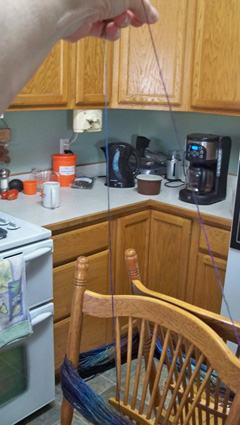
Guiding yarn from chairs to winder
Now a real yarn swift would have rotated and done most of the work for me, but I don’t own a swift, remember! So I had to become a “human yarn swift” and guide the yarn above the chairs (because obviously, my chairs don’t rotate)!!! I got a bit of a shoulder and arm workout but not too much!
It took me quite a while to wind the yarn, but it was definitely worth it. Now I’ll be able to use this yarn when I have an idea of what it wants to be (and when I have the time to devote to this project)!
Doesn’t this look nice and neat? This electric winder really does a nice job. I can pull the yarn from the center or the outside of the ball, whichever I choose.
Yarn on winder
If you use another method to wind your yarn into nice, neat balls, please share it with all of us here at The Crochet Architect! Or if you own an electric yarn ball winder, let us know how you like it!
I really love to crochet and to design new crochet patterns (basically, I love to make things!). But not just the typical types of crochet projects: scarves, hats, ponchos, shawls, garments, potholders, coasters, placemats, jewelry, etc. Sometimes I like to design something different and challenging. I get bored doing the same thing over and over. That’s why I like to change what I do from time to time!
Did you know that you can make artistic, 3-D items in crochet? I’ve designed and crocheted several myself. I’ll show you those a little later in this blog post. But first, I’d like to show you some of the amazing things that some crochet artists are creating around the world. These projects are very inspiring and really amazing!!!
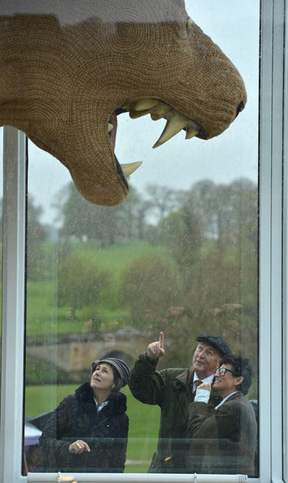
Lion Head from The Lionheart Project
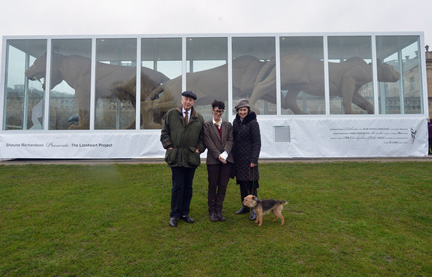
The first artist I’d like to share with you is Shauna Richardson. Shauna spent 2 years and used 36 miles of Swaledale wool from the Derbyshire Dales to crochet three giant 29 foot lion figures, known as “The Lionheart Project”! These lions are an interpretation of the three golden lions on Richard the Lionheart’s coat of arms. These lions are amazing!!! It would be wonderful to see these in person! These are just a few of the photos of this amazing creation. In these two photos, Shauna is chatting with the Duke and Duchess of Devonshire as they stand next to her project on May 1, 2012 in Chatsworth, England. The work will tour the East Midlands before moving to London’s Natural History Museum as part of the 2012 Cultural Olympiad. There are more photos of Shauna’s work and this impressive sculpture here: www.shaunarichardson.com and www.lionheartproject.com. And here is a website where you can watch a BBC video on this project: http://www.bbc.co.uk/news/uk-england-derbyshire-17922125.
Display of The Lionheart Project
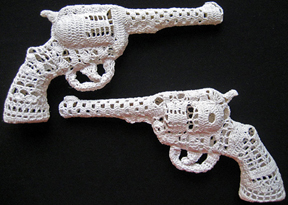
Crochet Pistols
Now for something a lot smaller! I saw these crocheted pistols online one day by Inger Carina and thought they were pretty amazing! I hadn’t seen any crocheted guns before I saw these. Isn’t it amazing what you can create with just a crochet hook, some crochet thread and some fabric stiffener (and some guns to mold them around, of course)? I would have never thought to crochet guns!!! Now that’s imagination for you! You can see more of Inger’s work at www.hellocraftlovers.com.
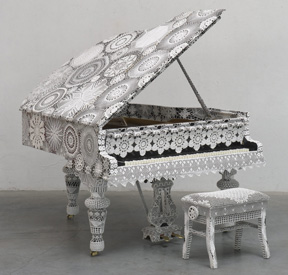
Piano covered with doilies
If you’re wondering what to do with all those doilies you’ve made and/or collected over the years, here is an idea for you. How about covering a piano with them? I think this covered piano is awesome!!! There are a whole lot of doilies covering this piano! Of course, I LOVE doilies!!! This was done by Joana Vasconcelos. You can see more of her work at www.joanavasconcelos.com.
These are just a few of the crochet artists in the world. Aren’t they amazing?
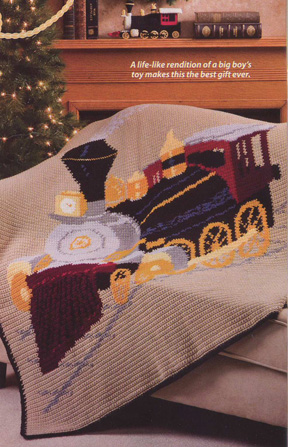
Well, my crochet art isn’t as nice as these fabulous pieces, but it’s not bad! First, here is my locomotive afghan and toy, which were published in the December 2009 issue of Crochet World magazine:
Locomotive Afghan
The locomotive afghan was made with 9 colors of Red Heart Super Saver yarn. It measures 48” x 60”. When designing this afghan, the first thing I needed to do was find a good photo of a locomotive at the desired angle I wanted. Since I had trouble finding a good photo, I took some photos of a plastic toy locomotive that we used many years before under our Christmas tree (it had optional smoke, too). After making a gauge swatch, I decided how many stitches and rows the afghan should have for the desired size. Then I imported the photo into my computer charting program and tweaked the colors in the chart to make a good intarsia pattern that didn’t have too many color changes involved.
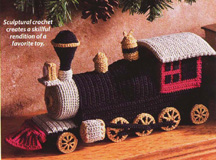
Locomotive Toy
The locomotive toy was made with 5 colors of J&P Coats Royale Classic and Metallic crochet thread in size 10. Many parts of the toy are crocheted with 2 strands of crochet thread held together. I used plastic canvas, cut into various sizes, to provide a “skeleton” for the crochet to fit over for the body of the locomotive. I also used polyester fiberfill to stuff many of the pieces. Since I didn’t know much about locomotives at the time, I checked out some books at my local library with photos of locomotives. And I asked a friend’s husband with locomotive knowledge some questions about the names of the parts of the locomotive so I could label them correctly in the pattern! It was a long process, but I think it was well worth it! This locomotive toy was a challenge to design, but it was actually quite fun!
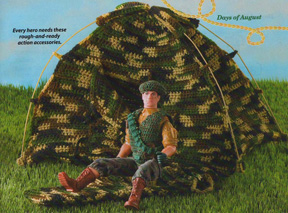
Here’s a tent, sleeping bag, beret, vest and ammo belt that I designed for a GI Joe (or similar) doll:
GI Joe Tent and Gear
This pattern was published in the August 2009 issue of Crochet World magazine (it was called “Camouflage Gear” in the magazine). The vest, beret, ammo belt and sleeping bag weren’t too difficult to design with the doll that I had received from the magazine editor to use. But the tent was a challenge!!! After trying several times to make the tent, I decided I needed to make a paper form of the tent first. Then I crocheted the pieces to fit the form. I cut a wire coat hanger and bent the wire a little to form the tent “poles”. I used pieces of a glue stick for the ends of the tent poles so they wouldn’t poke through the crochet pieces at the bottom corners of the tent. I even crocheted the door flap for the tent, with crocheted chains for tie straps to keep the door flap open or closed. I used Red Heart Sport yarn for the tent and sleeping bag and Aunt Lydia’s Classic size 10 crochet thread for the ammo belt, vest and beret. And I used bugle beads for the “ammo” in the ammo belt!
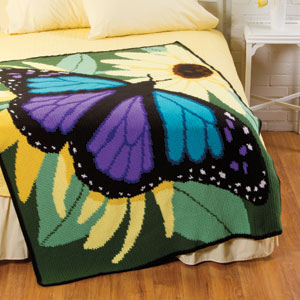
Here is my Majestic Butterfly afghan that was published as a web bonus in Crochet! magazine’s Spring 2012 issue:
Majestic Butterfly Afghan
This afghan was made as a request from Cari Clement at Caron yarns. She liked my locomotive afghan at the CGOA Conference the year before and asked me to design an intarsia afghan for Caron. So I started looking for photos of butterflies to use. I finally found one and used the same computer charting program to import the photo (after deciding how many stitches and rows the afghan would need). I had to do a lot of tweaking on this one to get the colors to work and not have too many color changes throughout the rows. I think it turned out nicely!
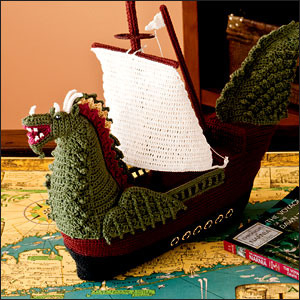
And last, but not least, is my Dragon Ship, which was published as a web bonus in Crochet World’s February, 2011 issue. The reason it wasn’t published in the magazine itself, but as a web bonus, is the pattern was way too long!!! I also won a Flamie award for this ship last year! The ship is designed to look like the ship in “The Voyage of the Dawn Treader” movie! The editor for Crochet World magazine at the time, Michele Maks, asked me to design this ship well before the movie was released, so finding online photos of it being built wasn’t all that easy!
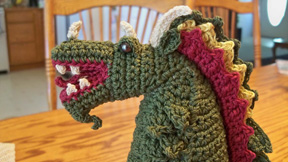
Dragon ShipThe head on my Dragon Ship
This dragon ship was the biggest challenge for me so far! I made at least 3 different heads for the dragon before I got one that didn’t look dorky!!! The dragon itself has a head, neck, wings and tail. I included teeth and a tongue in the open mouth, along with a goatee under the chin, horns, ears and bead eyes with eyelids on top of the head. The crochet stitches I chose for the sides of the neck and the tail look like scales! And I used some post stitches for added texture on the dragon’s wings. The ship includes a hull with embroidered port holes, deck, stern cabin (at the back of the ship below the tail), 2 masts, a sail, flag, lookout and side railings. I used 7 colors of America’s Best Crochet Thread, size 10 for this ship. I added cardboard pieces under the deck and under the top and front pieces of the stern cabin for strength and added shaping. I put poly pellets at the bottom of the hull and stuffed the rest of the hull with polyester fiberfill. I inserted wire at the bottom of the sail to help shape it. I stiffened the flag, lookout and 2 pieces that I made to attach the masts to the deck. My only regret is not engineering the masts and deck so the masts would not flop around! But all in all, I think this dragon ship looks pretty good!
I hope you’ve enjoyed looking at these pieces of crochet art (mine and the other designer’s pieces)! And I hope I’ve inspired you to try some crochet art in the near future!
You’ve probably seen crochet jewelry all over the place, but have you made any of it yet? I absolutely LOVE making (and wearing) crochet jewelry, whether it is one of my designs or someone else’s design!
Crochet jewelry that is made with cotton crochet thread (my favorite) is hand washable, so it will last for years! You can use any colors of crochet thread for making your crochet jewelry to coordinate with your wardrobe. The fasteners on crochet necklaces can be barrel clasps or buttons. Some are even long enough to fit over the head, so they don’t need any fasteners! Many crochet jewelry pieces take just a few hours to make, so they’re instant gratification projects, which I love!!!
Here are a few pieces of crochet jewelry that I’ve made from other designer’s patterns:
My Favorite Necklace
This is my favorite necklace, made with size 20 thread. The pattern is from a Magic Crochet magazine, Issue #64, Feb. 1990. I LOVE this necklace! It looks great on and is easy to clean when it gets dirty. I wear it a lot! I even made some coordinating leaf earrings to wear with it. The clasp is a simple button and crocheted buttonhole.
Necklace With Balls
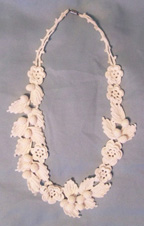
This necklace is fun to wear. It’s made with size 10 thread and includes matching “ball” earrings. I think this pattern was from a Japanese book by Kazekobo.
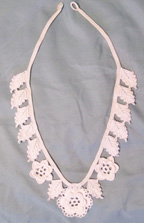
Irish Crochet Necklace
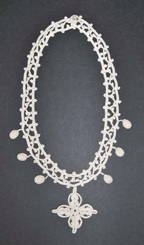
This Irish Crochet Necklace was made with size 20 or 30 thread. It’s too fancy to wear with just anything! The chains near the back of the necklace (at the top of the photo) twist easily, so I don’t wear this one very often. This necklace may have been from the same book by Kazekobo.
Here are some crochet jewelry pieces that I’ve designed for Crochet Today magazine over the years:
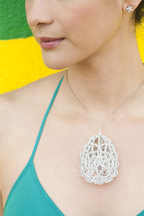
There is a large, clear crystal sandwiched in the center of the 2 sides of crochet in my Crystal Pendant Necklace! It’s pretty cool!!!
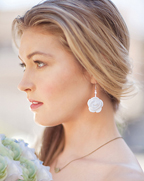
Bouquet Earrings May/June 2012
The Bouquet Earrings were made in white for a bride, but can be made in any flower color you choose!
Winter Berry Earrings Nov/Dec 2012
The Winter Berry Earrings are made with some shiny crochet thread, called Anchor Artiste Metallic. It’s a very pretty thread. The photo doesn’t do it justice!
Here are some of the other crochet jewelry pieces that I’ve designed:
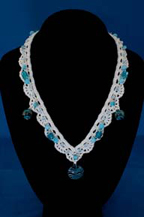
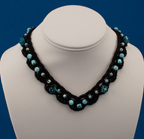
This is my Beaded Shells Necklace, available for purchase at TheCrochetArchitect.com. The pattern comes in 2 versions: long and short. They both have small beads throughout, but the longer version includes 1 large center bead and 2 medium beads.
Faux Tatted Necklace with buttonsFaux Tatted Necklace with beads
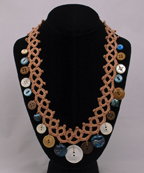
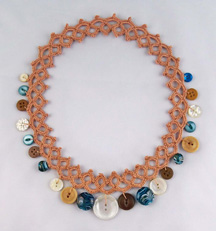
This is my Faux Tatted Necklace pattern, also available for purchase at TheCrochetArchitect.com. This necklace is actually crocheted to look like tatting, which has rings, chains and picots. This pattern can be made with buttons, beads or charms. It is a fun project to make with heirloom buttons or buttons with memories attached!
I love making these crochet necklaces and earrings because they’re so versatile!
For my Faux Tatted Necklaces (I’ve made quite a few), I’ve used many different colors of size 10 crochet thread and beads or buttons to coordinate with some of the outfits in my wardrobe. This necklace doesn’t have a clasp, so you just pop it over your head and wear it (it’s great if you have an injured hand, wrist or arm!). I should be coming out with a pattern for a coordinating Faux Tatted Bracelet and Earrings soon, so you can wear a complete set of Faux Tatted jewelry, if you like!
Why not make some crochet jewelry for your next project? If you do, please drop me a line and let me know how it turned out!
Because of the number of “Spam” comments I’ve been receiving at The Crochet Architect.com, I have implemented a new way to leave comments on blog posts. Like many other forums and blog sites, you will be required to log in as a friend of my site before leaving a comment. You will only need to sign up for an account once. It is quick and painless, but should alleviate the number of spam comments I’ve been receiving. You will still receive updates to my blog posts without having an account (if you’re subscribed to my blog). The account is only needed if you’d like to leave a comment on a blog post. This account is separate from a customer account for purchasing crochet patterns at The Crochet Architect.com website.
I look forward to hearing what you have to say about my blog posts. I’d love to get a dialogue going and discuss any crochet topic you’re interested in discussing. If you have a suggestion for a crochet related blog post, please send me a message on the “About Me” page. If a blog post has touched you, inspired you or taught you something new, please let me know by commenting.
If you’ve purchased one of my patterns and have any questions about it, please ask by sending me a message. If you’ve crocheted a project from one of my patterns, please send me a photo of it. I’d love to see it!
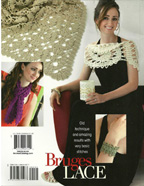
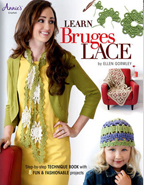
Learn Bruges Lace back coverLearn Bruges Lace front cover
When I taught my Beginning Bruges Lace class at the CGOA Conference in 2010, I had no idea that one of my students would go on to design so much in Bruges Lace. But she did! That student is Ellen Gormley. She not only has had many Bruges Lace designs published, but she’s also come out with a new crochet book/leaflet called “Learn Bruges Lace”, published by Annie’s. You can see and purchase this book at http://www.anniescatalog.com/detail.html?prod_id=90152.
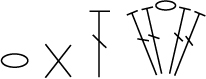
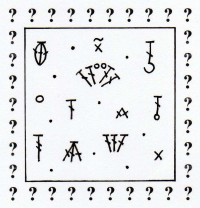
Ellen has done a great job with this book. It includes step-by-step instructions for 10 stitch patterns in Bruges Lace to learn this crochet technique. Once you’ve learned the technique, you’ll want to make some (or all) of the 8 Bruges Lace patterns in the book, which Ellen has designed: 3 hats, 2 scarves, a blanket, a bracelet and a cowl. Each pattern (and each beginning stitch pattern) includes written instructions, as well as a symbol chart. If you haven’t learned to read crochet symbol charts, you’ll really want to learn. Crochet symbols are a visual representation of the project, showing all the crochet stitches worked in the project in symbol form. Here is an example of crochet symbols:
Crochet Symbols
Once you learn to read crochet symbols, you’ll never be the same! You can make many more crochet projects from patterns which are only written in crochet symbols, such as in Magic Crochet and Decorative Crochet magazines, along with Japanese and Russian crochet magazines, such as Duplet. I’ll be teaching a class at the CGOA Conference next week in Reno on Crochet Symbols. If you’re in the area, there is still room for a few more students in this class! You can read about the CGOA Conference and all the classes being offered here: http://www.knitandcrochetshow.com/fall-special-events.asp?i2s3. There are a lot of great classes to choose from, both crochet and knitting!
Back to Ellen’s book! If you’ve never tried Bruges Lace, it’s easy (and fun) to do once you know how. You can use crochet thread or yarn, whichever you prefer. Ellen’s book is easy to understand, laid out well and has great stitch patterns, as well as projects. My two favorite projects in this book are the Spiral Cowl and the Dune Throw. Here are photos of those two projects:
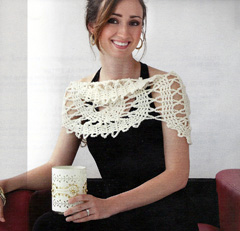
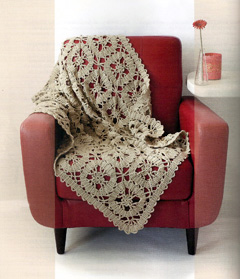
Spiral CowlDune Throw
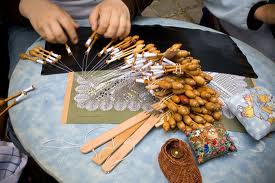
Bruges Lace uses regular crochet stitches, such as chain, single crochet, half double crochet, double crochet and sometimes treble crochet. It’s just the way the stitches are laid out that makes it Bruges Lace! If you’d never heard of Bruges Lace before, it is a lace technique which originated in Belgium. The “real” Bruges Lace is made with many tiny wooden bobbins that are filled with thread and crossed over each other to create intricate lace. Here is a photo of the bobbins that are used for the “real” Bruges Lace:
Lace making bobbins
Doesn’t that look confusing and difficult? There are master lace makers in Belgium, as well as other parts of the world. They put us to shame here in the US! I love lacy things, so I might learn to do bobbin lace someday, but not for a while. There are many more crochet projects that I’d like to design first!
Crocheted Bruges Lace is much easier to make than this “real” bobbin lace! All you need is a crochet hook and some yarn or crochet thread. You can combine Bruges Lace with crochet motifs in the same project, too. You can use one color of yarn/thread or multiple colors in different sections of the lace.
Here are a few photos of some crochet Bruges Lace that I’ve designed:
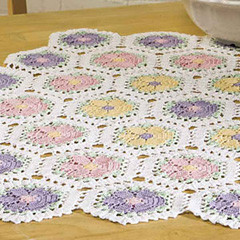
Daisy Tablecloth
This is a tablecloth that I designed with colorful center flower motifs which are done in regular crochet (not Bruges Lace). Only the white around the edges of each motif is done in Bruges Lace. This tablecloth was published in Crochet World magazine’s Spring 2011 special issue called “The Joy of Thread”. It was actually on the front cover, too. The tablecloth is made with size 10 cotton crochet thread. You can see all of the projects in this magazine here: http://www.ravelry.com/patterns/sources/crochet-world-magazine-spring-2011.
Vail Mountain Wrap (Bruges Lace)
This Bruges Lace Wrap that I designed is a free pattern on the Naturally Caron website. It is made with Naturally Caron Spa yarn. This yarn drapes beautifully and the wrap is very soft! You can download this free pattern here: http://www.naturallycaron.com/projects/vail_mountain/vail_mountain_1.html.
In conclusion, please check out Ellen Gormley’s new book, “Learn Bruges Lace” on the Annie’s website or at your local craft store to learn this crochet technique. You’ll be delighted with the Bruges Lace projects you’ll be able to create with your knowledge of this fascinating crochet teachnique!
Are you a crochet lover like me? Do you enjoy being around others who love to crochet, also? Then you won’t want to miss the CGOA Conference in Reno next month. It will be held at the Grand Sierra Resort from Sept. 12-16. There are many wonderful crochet (and knit) classes being offered. Go to http://www.knitandcrochetshow.com/fall-special-events.asp?i2s3 to see the schedule and description of all of the classes being offered and the special events at the conference, too. There will also be a shopping floor at the conference to buy new yarn, hooks, patterns, etc! Attending the conference is like being in “crochet heaven”!!! All the conference attendees speak the same crochet and/or knitting “language”! We all help each other and encourage each other in our crochet projects and classes! It is a wonderful experience!
The classes I will be teaching in Reno are:
Beginning Filet Crochet
BEGINNING FILET CROCHET (Thursday morning)
Intermediate Filet Crochet
INTERMEDIATE FILET CROCHET (Thursday afternoon)
If you’ve never learned to do filet crochet, you’re really missing something wonderful! You don’t need to use crochet thread and a steel hook for filet crochet, either. If you prefer working with yarn, you can make filet crochet afghans. The technique remains the same whether you use crochet thread or yarn! I love filet crochet because I can see the picture forming before my very eyes (and I love working with crochet thread)! It’s easy to design in filet crochet, too. All you need is a pencil, eraser and graph paper to draw your design. That’s how I started designing in filet crochet. I now have a computer program that makes nice filet charts for publication, but that’s not needed if your project will be for yourself or given as a gift. There are many beautiful filet crochet patterns, also, that are fun to make. Filet crochet can be used for pillows, coasters, placemats, afghans, garments and much more. You can even use a filet pattern that was designed with thread and use yarn instead! Of course, the project will be much larger, but you may desire a larger project than the original size anyway!
Playful Polish Stars
PLAYFUL POLISH STARS (Friday morning)
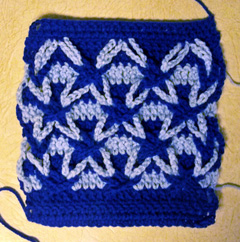
I think the Polish Stars technique is fascinating! I blogged about this technique on July 25th. If you read that blog post, you’ll see the before and after pictures of my Polish Stars swatch. The stars are formed when you weave the chain loops in the specified way. It’s really fun to see the stars take shape before your eyes when you weave them! Polish Stars can be used for many projects, as well. I’ll have a Polish Stars poncho on display at the conference in a special booth on the shopping floor from Thursday evening until Sunday afternoon. Please come by the booth and see a sample of this wonderful technique!
Simplifying Symbol Crochet
SIMPLIFYING SYMBOL CROCHET (Saturday morning)
I’ve taught many students to read crochet symbols in my classes at past CGOA Conferences. They all love the versatility of crochet symbols and they now have the knowledge to make any project from just a symbol chart (even foreign patterns like Japanese and Russian). Since I love thread crochet, I have many Decorative Crochet and Magic Crochet magazines. All of these patterns are written with very little words, but with a fantastic symbol chart that is easy to follow, once you know how! I’m so glad that I learned to read crochet symbol charts years ago. It really opens up a whole new world of crochet once you learn! And I’ve learned to make crochet symbol charts with Adobe Illustrator, too! Since I’m “electronically challenged”, it’s sometimes a challenge for me, but with the help of my good friend, KJ Hay, I’m learning more about Illustrator all the time! Thank you very much, KJ!
Intermeshing 101
INTERMESHING 101 (Saturday afternoon)
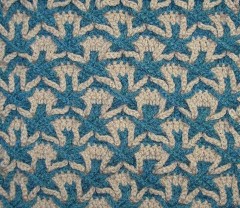
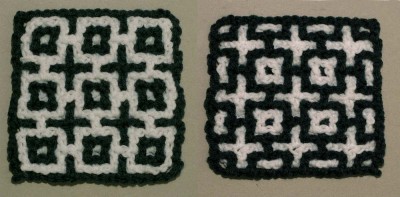
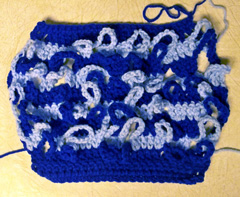
If you’ve never seen Intermeshing (aka: Interlocking) Crochet before, you’re missing something really cool! You can create reversible crochet fabric with different looks on each side! The photo shown here is actually 2 sides of the same piece! I’m a real “geometric” person, so Intermeshing appeals to me a lot! I love anything that isn’t “ordinary” crochet and gives me a challenge! You won’t find me with mindless crochet projects very often!!! If you’d like to read more about Intermeshing, please read my blog post on May 25! You’ll find a link to a wonderful Intermeshing/Interlocking book there, too.
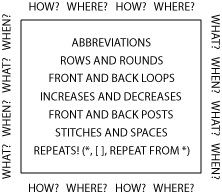
I don’t know how anyone progresses in crochet without knowing how to read a crochet pattern! I’ve learned a lot about reading, writing and editing crochet patterns over the last 3 decades and I’d love to share that knowledge with you in this class. If you’ve ever struggled with reading or understanding a crochet pattern, this class will give you the knowledge and confidence to push yourself further in your crochet projects. Once you learn to read a pattern with ease, you’ll find yourself crocheting projects you never thought you could make before!
If you’ve signed up for one of my classes, thank you very much! I look forward to meeting you in my class and/or at Professional Development Day in Reno. For those of you who are on the fence about what classes to take, I would like to “encourage” you to sign up for one of my classes. For whatever reason, I have low enrollment in my classes for the Reno conference, which puts some of them at jeopardy of being cancelled. I love teaching crochet and would be thrilled to have more of you in my classes. I’m very friendly and encouraging to all of my students. I strive to have fun, enjoyable classes for everyone!
Thank you for your consideration of my classes and the Reno Conference. For anyone who hasn’t decided about attending the Reno Conference, please make the decision to attend the conference. It is so enjoyable to be around like-minded people who love to crochet and learn new crochet techniques for almost a week!!! I’ve heard that if the Reno (west coast) conference isn’t well attended, the conference probably won’t return to the west coast for a while. It would be a shame for those of us who live on/near the west coast to lose having the conference close to us. My classes at the Manchester conference in June of this year were very well attended, as was the whole conference. Please, let’s rally together and make the west coast conference as well attended as the east coast conference!
For the past 2 days, I’ve been working on the contents of my Polish Stars class that I’ll be teaching at the CGOA Conference in Reno, NV in September. I had some swatches already made, but needed to make some new ones that aren’t as big for the class swatches. And, of course, I’ve been writing and checking the new patterns for these swatches, too! I tried following the patterns in some leaflets that I have on Polish Stars, but I’ve found a lot of errors in the instructions, so it’s back to the drawing board! If you’ve never seen a Polish Star in crochet, this is how it looks:
Polish Stars (after weaving loops)
They’re actually quite fascinating to make! They are worked in rows of alternating colors. The stars are formed when you weave the chain loops in a certain configuration. I found a YouTube video on weaving the stars, but she does it wrong! I pity the person who follows her directions!!! Their stars won’t turn out right at all!
Polish Stars (before weaving loops)
Here’s how this swatch looked before weaving the loops:
That’s quite a jumbled up mess, isn’t it? It almost looks as if there are mistakes in it! But have no fear! After weaving the loops, it turned into the well-mannered, finished swatch with the stars that I already showed you. Are you amazed?
Well, a few years ago, I tried the Polish Star technique that was in publication and decided to improve it a little. I came up with a less messy way to work the Polish Stars and I’ll be unveiling it in my Playful Polish Star class in Reno in September. If you’re interested in learning this technique, you can read about my class and sign up to take some crochet or knitting classes here: http://www.knitandcrochetshow.com/fall-special-events.asp?i2s3. This class will be held on Friday, September 14 from 9AM – Noon. There are a lot of other wonderful crochet and knitting classes being taught at the CGOA Conference in Reno that week, too.
If you’ve never been to a CGOA Chain Link Conference before, you don’t know what you’re missing! It’s a week of “crochet heaven on earth”!!!
We have 3 new crochet patterns for you at The Crochet Architect. They’re all fun to crochet and will be a wonderful addition to your kitchen table or to use for outdoor dining!
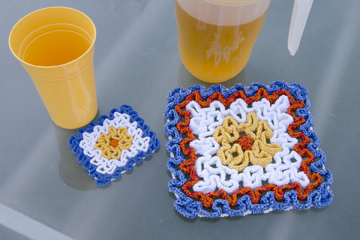
Wiggly Flower Hot Pad & Coaster
The first is our WIGGLY FLOWER HOT PAD & COASTER. This set is made in the wiggly crochet technique with size 10 cotton crochet thread. The hot pad is made with 3 strands of the thread and the coaster is made with only one strand.
This pattern includes written instructions and wiggly crochet charts for both designs.
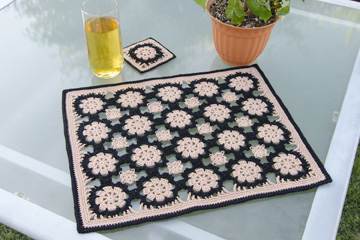
Byzantine Placemat & Coaster
The second is our BYZANTINE PLACEMAT & COASTER. This set is made with any 2 colors of size 3 cotton crochet thread. The placemat is made with large and small motifs, which are joined together while working the last round of each motif. Then an edging is worked around the joined motifs for the perfect finish. The coaster is made from only one of the large, round motifs, with an edging added to make it square.
This pattern includes written instructions, a crochet symbol chart for each project and an assembly diagram for the placemat.
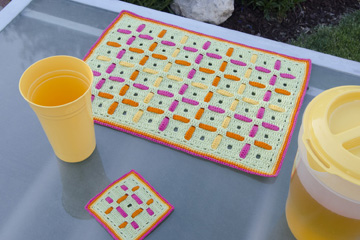
Filet Woven Placemat Set
The third is our FILET WOVEN PLACEMAT SET. This placemat set is made in the filet crochet method with double crochet stitches and ch-2 spaces. It has added crochet strips of contrasting colors that are woven through the appropriate ch-2 spaces for visual interest! The placemat is made with 2 strands of size 10 cotton crochet thread held together throughout and the coaster is made with only one strand of the same threads. You can choose to make these projects in any colors you desire for spring, summer, fall or winter décor!
This pattern includes written instructions and a crochet symbol chart for each project.
I hope you enjoy these patterns and the extra pizzazz they are sure to bring to your table! If you have any questions about these patterns, please don’t hesitate to ask!
I returned home last Monday, July 2nd, from the CGOA Chain Link Conference in Manchester, NH. It was a blast!!! I taught 6 classes and met a lot of really nice crocheters, knitters and tatters there. If you have the chance to attend the conference, I recommend that you go. You won’t be disappointed!
My plane took off from Phoenix Sky Harbor Int’l Airport, heading to Manchester on Tuesday, June 26, 2012. The flight made a scheduled stop in Denver, then continued on straight to Manchester from Denver. That morning, I remembered that a designer friend of mine, Andee Graves, lives in Colorado. I was wondering what flight Andee might be taking, so I watched for her when the new passengers came onto the plane in Denver. To my surprise and delight, Andee got on the plane!!! After I got her attention, we sat next to each other and talked the whole way to Manchester, which made the time pass a lot faster!
The first day of the conference was Wednesday, when I attended Professional Development Day (PDD for short). It was a day packed with information for crochet professionals or aspiring crochet professionals. At PDD, I learned more about designing, tech editing, self-publishing, using social media, teaching and producing crochet videos. These and many more topics were presented by other crochet professionals there. KJ Hay’s presentation about tech editing was hilarious and very creative! Instead of reading the information she wanted to present, she made a little “skit” out of it, complete with her bunny slippers! It was a riot! I’ll be presenting the topic of “Contract Crocheting” at PDD in Reno in September. It should be a lot of fun.
Kathryn White at PDDTerry Kehrer at PDD
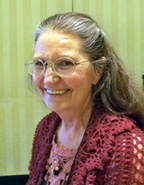
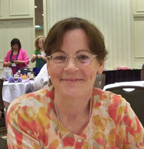
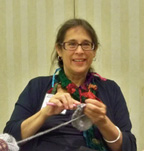
At PDD, I sat at a table with Kathryn White, Michele Maks, Theresa Kehrer, Joyce Bragg and Karen Ballard. Here are photos of 3 of them:
Michele Maks at PDD
Then on Wednesday night, I taught my first class at the conference: Symbol Crochet. All the students were eager to learn and did very well in class. It was a little difficult to teach a class after a full day of PDD because I’m a morning person, not a night person! But I persevered and was able to think straight, must to my surprise and delight! I must have been running on adrenaline!
On Thursday morning, I taught my Faux Tatted Necklace class from my pattern with the same name. Here’s a photo of the necklace:
Faux Tatted Necklace
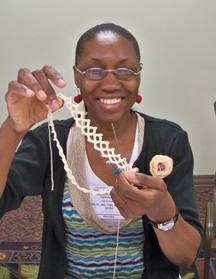
Carlotta and her necklace
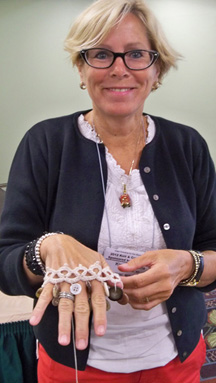
Kim and her bracelet
And here are some of the happy students with their necklaces (or bracelets) in progress:
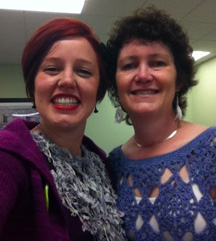
Victoria and me
There was also a mother and daughter in that class. This is the daughter and me:
I was amazed and extremely surprised that one of the students in that class had taught herself to crochet the night before! She was still learning how to hold the hook and thread, but she was patient and persistent and she did great!!!
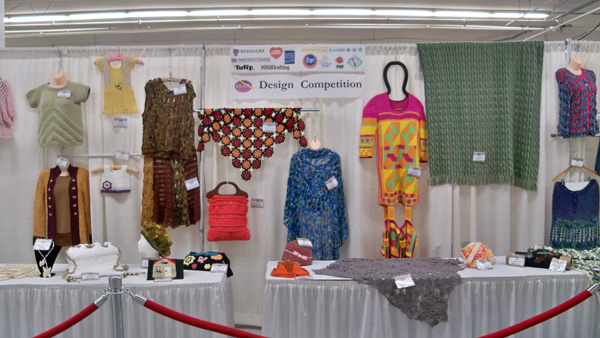
I had Thursday afternoon off from teaching, so I spent it with one of my mentees, Theresa Kehrer. On Thursday night, they held the Design Contest Awards. Here’s a photo of the center of the display with all the entries, located on the show floor (Note: Not all the entries are shown in this photo, just the ones in the center of the display):
Design Competition Display
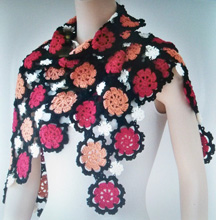
I entered my new shawl pattern that I made in the continuous crochet motifs method (I blogged about it on May 19), but I didn’t get a prize for it. Here is a photo of that shawl:
Byzantine Shawl in Design Contest
All of the black around the large red and orange motifs is done with one strand (actually 2 strands because I needed to use 2 balls of black yarn) so there are only 4 ends of black yarn to weave in when you’re done crocheting the shawl instead of 128! I’m thinking about designing an edging for this shawl before I publish the pattern. I think it needs a little something extra. It’s too bad I didn’t add an edging before entering it in the contest. Oh well! Better luck next year!
After the Design Contest Awards came the shopping floor preview, which is always a lot of fun! Who doesn’t love looking at and touching beautiful yarns?
I went to the Dance Party for a little while after that, but left in plenty of time to get a good night’s sleep so I could think straight the next morning to teach classes again! It’s important to me to be my best and think as clearly as I can when I’m teaching. I owe that to my students. And that doesn’t include staying up until the wee hours of the morning!!!
Whenever I have to travel to the East Coast for the CGOA Conference, I start adjusting my internal clock 2 weeks before the conference so I don’t have to try to adjust to the 3 hour time difference in one night! It works great! Over the course of the 2 weeks, I was able to eventually go to bed and get up in the morning 2-3 hours early before I left for the conference, so I was already used to East Coast time when I got there!
On Friday, I taught my Beginning and Intermediate Bruges Lace classes. Both of these classes went well and the students enjoyed learning how to form several styles of Bruges Lace tapes, how to curve them, join them to each other (and to motifs) and loop the tapes over themselves. It was a great day!
That night, the CGOA Annual Member Meeting took place. Normally, I sit with the other members in the audience, but this time I sat at the head table with the CGOA Board members. I had to keep the secret for weeks of me filling a vacancy on the Board: Karen Whooley is leaving the Board due to family matters. This is the first time I’ve been on the CGOA Board in the 10 years that I’ve been a CGOA member. I’m looking forward to giving back to CGOA and helping to improve the CGOA Masters Program (I’m the new liaison to the new Masters Committee: Jane Rimmer and Carol Moore are taking the places of Karen Whooley and Kathleen Sams as co-chairs of the Masters Committee).
On Saturday, I attended my first CGOA Board meeting bright and early at 7AM with the other Board members (I’m glad that I’m a morning person!). However, I had to leave the Board meeting early in order to teach my Shuttle Tatting class all day! Every one of the 11 students in the class learned to shuttle tat at various skill levels. It’s not exactly an easy thing to learn, but they were all patient and persistent students! I’m very proud of every one of them! I can’t wait to see what they create in shuttle tatting!
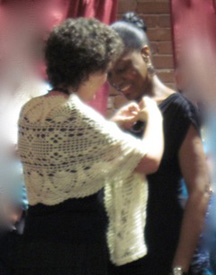
The Fashion Show and Dinner was held on Saturday night. I modeled in the Fashion Show and pinned a Masters Pin on one of my mentees, Carlotta Craig. Here we are in the pinning ceremony:
Pinning Carlotta!
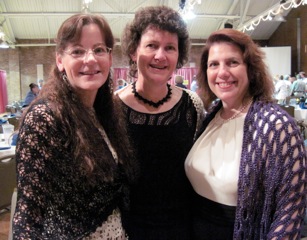
It was a wonderful night and it was hard to say goodbye to many friends at the conference, as many people leave that night or the following morning. I saw Karen Manthey, Bobbie Matela, Carol Alexander, Kathleen Sams and many, many more friends and colleagues at the dinner and conference. Here is a photo of me at the Fashion Show (in the center) with 2 of my mentees: Theresa Kehrer (on the left) and Shari White (on the right):
Terry, Shari and Me
I taught my last class, Writing Crochet Patterns, on Sunday morning. The students in this class were all very eager to learn more about writing crochet patterns and improving their pattern writing skills! Many of them were newer or beginning designers. I look forward to seeing their design careers grow!
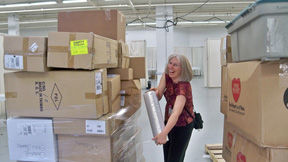
After having lunch with Jane Rimmer and Carol Moore on Sunday afternoon, I walked into the show floor and found myself volunteering to help take down the Red Heart/Crochetville booth. It was a lot of fun! I received many skeins of free yarn and crochet thread for my efforts!!! Normally I wouldn’t accept so much yarn at a conference because I’d have to find a way to get it home! But I knew I had extra space in my second suitcase because I gave out so many handouts in my classes and that space was now vacant to fill with yarn on the way home!!! Thank you very much, Kathleen! I will use the yarn for some crochet designs as soon as I find some extra time to make them! Here’s a photo of Andee Graves wrapping up the boxes on the pallets with plastic/shrink wrap before the driver took them away:
Andee wrapping boxes
All in all, I had a wonderful time at the conference and I’m looking forward to teaching 6 more classes at the CGOA Chain Link Conference in Reno in September! I’d better get to work and prepare those classes before time slips away! It’ll be here before I know it!!!
If you are a crochet enthusiast like me, and especially if you’ve been crocheting for as long as I have, then you have certainly run across the name of Jean Leinhauser. Jean was one of the pioneers and legends in the crochet industry. If you’ll indulge me, I’d like to tell you a little about Jean.
Jean was born in August, 1933 and passed away one year ago, on June 12, 2011. She worked in the needlework field for 4-5 decades! Back in 1964, she was working as Design Director for the Boye Needle Company in Chicago. She had put together a knitting program that could be used in inner city high schools and was asked to do a crochet program, too. But Jean didn’t know how to crochet! So she spent 4 days at home teaching herself to crochet and came up with the crochet program for Boye. She also wrote the information for their packaged crochet products and started doing leaflets with crochet patterns for them, as well. At that time, the only crochet patterns that were published were by yarn companies.
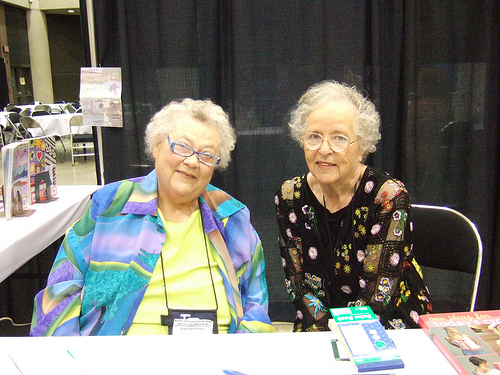
In 1971, Jean realized how much money Boye was making on the leaflets she was doing, so she decided to start her own company! That was the beginning of Leisure Arts, the first needlework pattern publisher that was not associated with a yarn company. Six years later, Jean sold Leisure Arts and started American School of Needlework (ASN), where she also published needlework leaflets. Sometime in 2002, Jean sold ASN to Dynamic Resource Group (DRG), the owners of Annie’s Attic, the Needlecraft Shop and House of White Birches. Jean stayed with DRG for 2 years as editor of Crochet! magazine. Then in 2004, she left DRG and started producing crochet books with her good friend, Rita Weiss, who worked with her for many years at ASN. Over the past 5 decades,Jean Leinhauser published hundreds, if not thousands, of crochet books and leaflets. I have dozens of Jean’s books in my crochet library to this day. Here is a photo of Rita and Jean at a Crochet Guild of America (CGOA) Conference (Jean is on the left and Rita is on the right):
Jean and Rita
I first met Jean in January, 2002, at a craft trade show (HIA) in Anaheim, CA when Jean still owned ASN. Jean was sitting at a table with Rita Weiss and Bobbie Matela. I was in awe of meeting this crochet legend and a little scared, too! I was a new designer and didn’t have many designs published at the time. Jean looked at photos of some designs I had made and to my surprise, she bought a couple of them!
Fast forward 2 1/2 years to the summer of 2004. I was working on a paper quilling book that God had dumped in my lap (without me even having to submit a proposal for the book). Jean and Rita had just started their new book producing company called Creative Partners and were looking for someone to hire as a technical editor for the crochet patterns in their books. I had never done this type of work before and said I had an interest in being a tech editor. To my total shock, Jean remembered meeting me at the trade show over 2 years before! She gave me their tech editing test and I passed the test, to the surprise of all 3 of us!
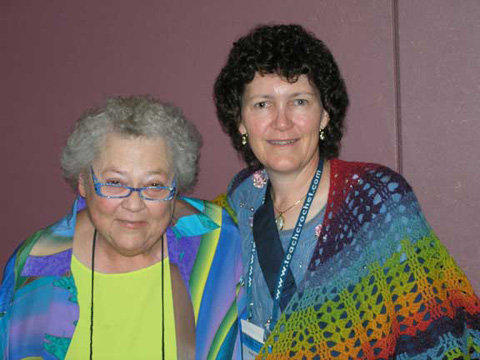
Jean was always encouraging, kind, loving, understanding and more. She always encouraged new designers. She loved people and took a genuine interest in everyone she met. She was my biggest and best mentor, teaching me the ropes of tech editing and starting my tech editing career. I will always be indebted to her. We had great fun e-mailing each other for quite a few years about editing and the challenges it poses. Whenever I felt like pulling my hair out, Jean would say something in an e-mail that made me laugh, which eased my frustration. She had a funny sense of humor, or as Marcy Smith, the editor of Interweave Crochet magazine called it, “a wicked sense of humor”. She was always interested in what was going on in my life and always had love and encouragement to share with anyone in need. Jean attended all of the CGOA Conferences, along with Rita Weiss. She was my “class angel” at the 2009 conference where I taught 4 classes with only one hand because I had broken my wrist 2 1/2 weeks before! Here is a photo of Jean and me at that conference:
Jean and me
Jean and Rita were 2 of the 3 members of the “Old Broads” club. The other member of the club was Margaret Hubert. All 3 of them wore sparkly rhinestone pins that said “Old Broads Rule” at the CGOA Conferences. It is a little uncertain to the rules of club membership. Some say members in this exclusive club had to be over a certain age or had to be in the publishing business for as long as Rita and Jean. Others say you had to be a knit/crochet designer still working in the industry and you had to have your first book published before 1968! In any case, the 3 of them wore their pins with pride and we all laughed at this exclusive club!
In July of 2011, at the CGOA Conference in Minneapolis, MN, Jean Leinhauser was the first inductee (posthumously) into the new CGOA Hall of Fame. The CGOA Board of Directors voted to rename the Hall of Fame in Jean’s honor. It is now called the Jean Leinhauser CGOA Hall of Fame. This year, Margaret Hubert will be the second inductee into the Hall of Fame. To read about the Hall of Fame, visit the CGOA website here.
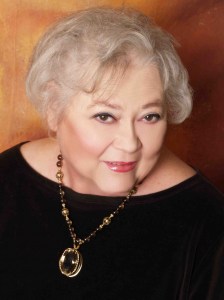
Several years ago, Jean and Rita decided to get “glamour” shots for including in some new books by Leisure Arts. Here is Jean’s glamour shot:
Jean’s glamour shot
She was beautiful to me, with or without makeup!
I will never forget Jean. She impacted so many lives and is deeply missed by many people. She was an inspiration to all designers, many of whom were extremely afraid to meet her (according to the stories I’ve read)! But Jean was humble and approachable, even though she was a “legend” in the needlework industry.
She was a huge blessing to me. I thank God for bringing her into my life and for allowing me to be her friend, as she was mine.
Rest in Peace, Jean, knowing that you are loved and missed by thousands of people worldwide.